


BUSHY™ enjoyed a solid week last week amid the general turmoil in equity markets. Full report below.

A quick reminder that the BUSHY™ portfolio is investable via a single click on the Plutus platform (as will the ‘20-for-20’ when launched) - full details in my July launch note linked below or the website via the button underneath.

History Needs Hardware
For newer subscribers, a quick reminder as to the background and thesis for the ‘🐿️-20-for-20’ project.

Report 2 covered the financials sector, focused on the plumbing of the world in two decades’ time - shortlisting only one commercial bank globally, 3 insurers, 2 exchanges and 3 other asset light intermediaries.

… while Report 3 took on the resources sector, shortlisting 4 energy stocks, 4 precious metal pure plays and our preferred 2 copper plays:

Now we turn to the sector that helps convert those resource atoms into real stuff - the global (military and commercial) industrials complex. I currently have 61 candidates in the long list - names straddling multiple GICS industry sectors.
I have broken the long list down into 5 sub-groups (several companies crop up in multiple groups). The semiconductor supply chain will be handled separately.
Power & Grid (including energy storage)
Aerospace & Space
Defense & Security
Machinery & Automation
Infrastructure & Logistics
No changes to the framework. Long list names are screened against our mosaic of ten potential world-states for 2046 (remember these are lenses, not forecasts and can contradict / overlap). Shortlisted names will be companies that can thrive in multiple scenarios.
For industrials, the theme mosaic hits differently. In resources, the themes pointed us towards particular commodities and sub-sectors. Here, almost every theme creates an industrial shopping list. The harder question is which on the list can generate durable shareholder returns - and how much we are already being asked to pay for them.
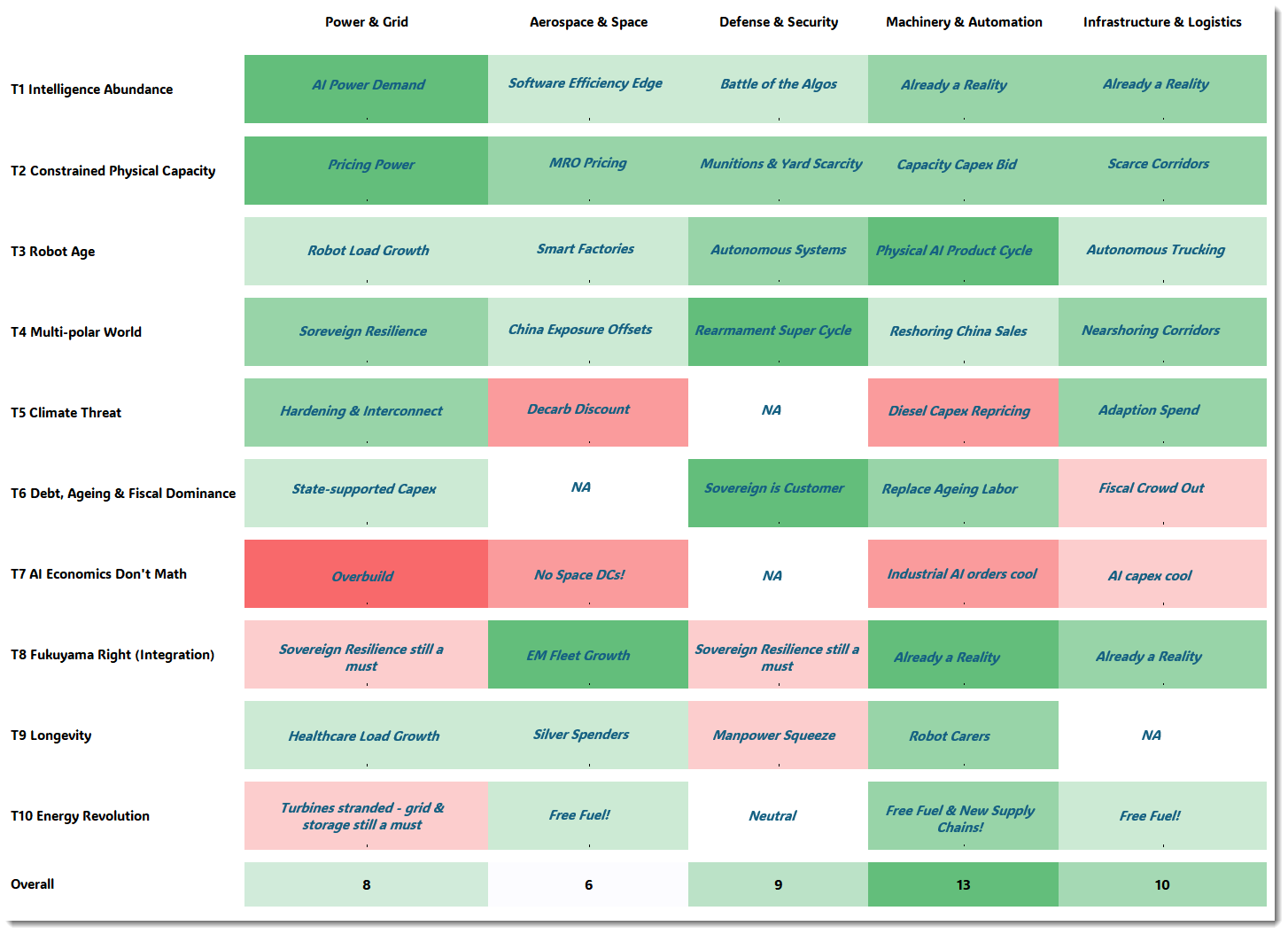
Even Longevity (T9), which I saw primarily as a healthcare / insurance theme before, becomes an important theme for the industrials. Larger, aged societies will of course compete for resources and services and we need to think about a world of robo-nurses!
T2 (Constrained Physical Capacity) the theme that dominated the resources report will clearly be critical with respect to all industrials segments - the problem will be underwriting some full valuations.
Two big tensions stand out from the broader industrials debate.
Expensive Plumbing
First, the electrification wager. Everyone with a pulse now knows that the world needs more electrons. However the market has taken a multi-decade infrastructure build story and priced it like software stocks in their glory days!
Gas turbine and even humble cable makers trade as data-center / AI derivatives. Somewhere along the chain from a GE turbine via Prysmian submarine cable to a Vertiv chiller, the well-defined need to move kilowatts has become a pricy bet on sustained capex enthusiasm.
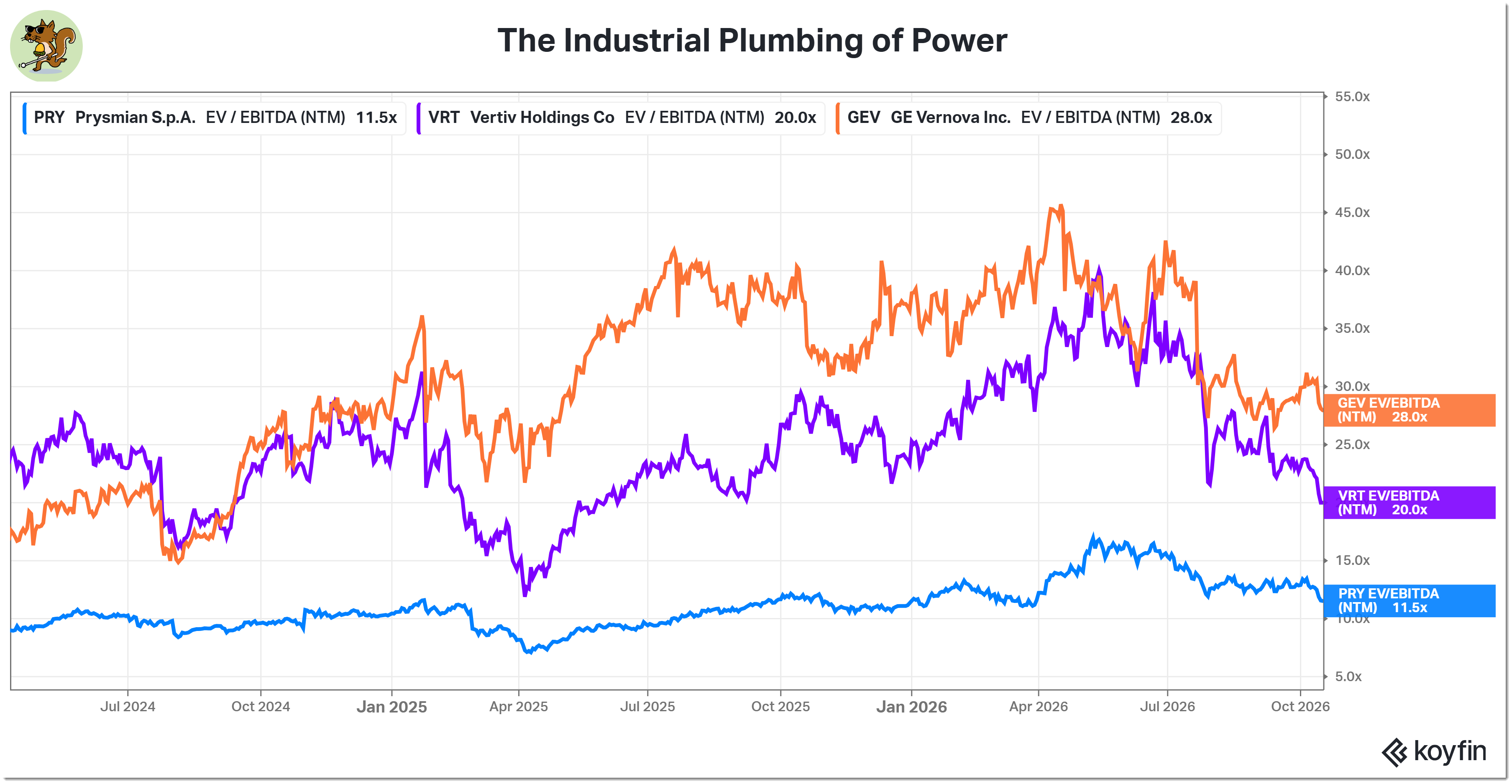
This summer has seen some of the heat taken out of multiples but they continue to trade at levels that could easily halve again with any further market questioning of the AI capex narrative.
The Spend Stays even if Fukuyama was Correct
The second tension relates to history, or rather about what it costs to be wrong about it! Defense spending gets lazily talked about as a bet on conflict continuing. I think this framing is wrong. Rearmament is a bill that Europe deferred for thirty years. The past five years have finally focused political minds.
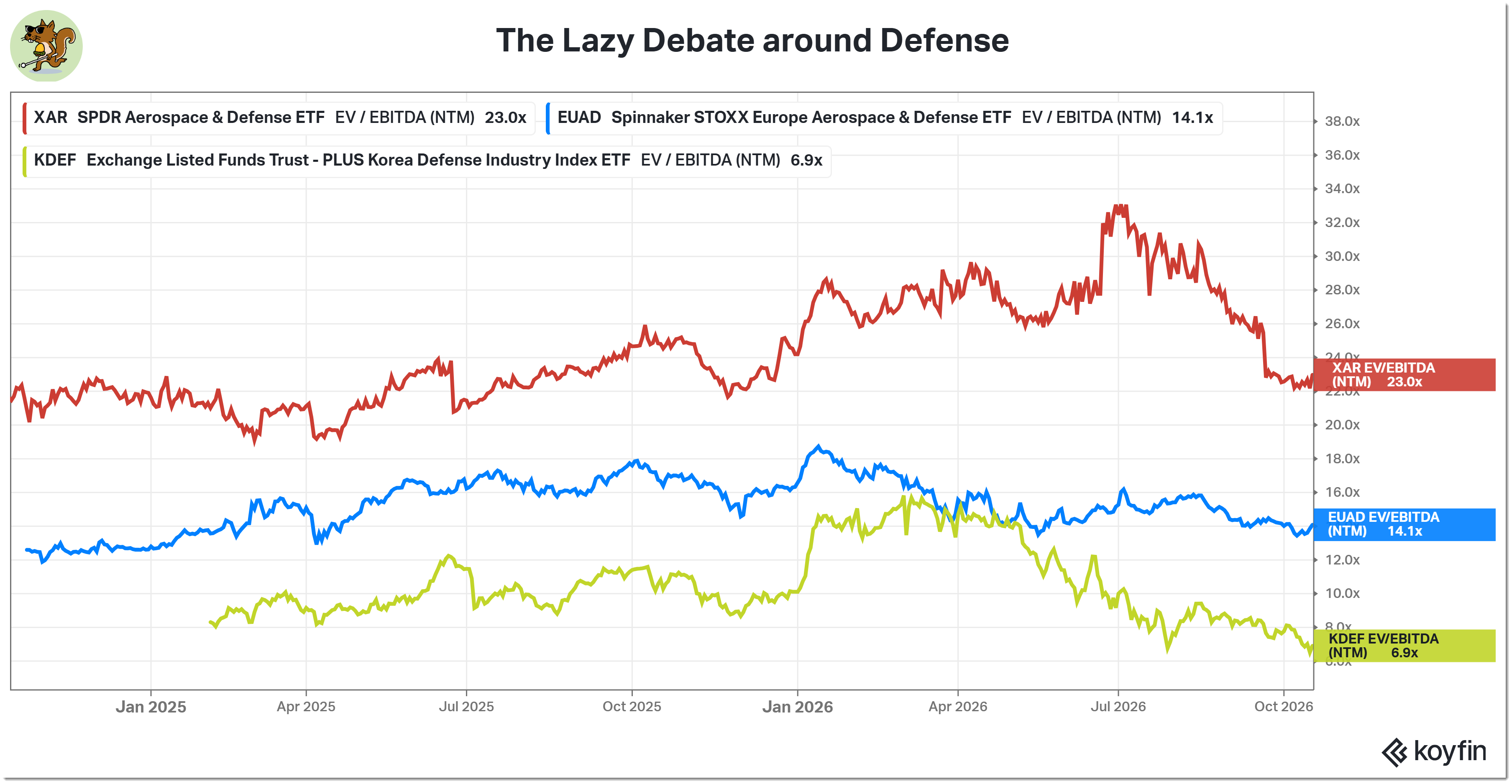
The defense thesis does not require an endless escalation of conflict. Stockpile replenishment, replacement programs and the rebuilding of industrial capacity provide a demand case even in a less hostile world. That is not a guarantee against budget reversals or against overpaying for the contractors.
Civilian aerospace offers a different route through the mosaic. Under T8, growing emerging-market traffic and higher aircraft utilization would work the installed fleet harder, supporting the engine aftermarket and its recurring service revenues.
The Elephant in the Room

When it comes to industrials, China sits above our theme mosaic. It is the customer, supplier and competitor sitting behind almost every global industrial business. You can buy a Japanese robot maker, a European electrical-equipment company or a Korean shipyard. But none offers an escape from the China question.
As my pals Kuppy and Louis Vincent Gave like to say “When China enters the room, margins leave” - this is is a useful starting point for industrial underwriting and a warning against extrapolating today’s profitability twenty years into the future.
The European Parliament’s March study on China’s industrial overcapacity (linked to via the image above) describes the problem - formidable manufacturing capacity competing for demand, with consequences for prices and returns both inside China and overseas.
It would be comforting to dismiss all of this as subsidies and wasteful excess capacity. Also a suboptimal process for picking stocks. A business that can defend its margins against an inferior product is one thing - but in many cases, Chinese high tech products are already both better and cheaper.

Nor does Chinese industrial success necessarily translate into attractive returns for shareholders in Chinese manufacturers. For example, I think there are strong arguments that BYD is the world’s most impressive industrial company. Does that make it ‘a lock’ for the ‘20-for-20’ book? Not necessarily. As a tool of China’s national industrial policy, this great business may not necessarily end up being a great stock.
In a deglobalizing world, are margin structures being created outside of China that are truly unsustainable? A reshoring beneficiary operating behind trade barriers may report excellent returns on capital, strong pricing and a reassuring order book. But we have to distinguish between earned margins and those that are granted by policy.
Protectionism can be durable. Sovereign resilience is one of the reasons we are looking at these businesses in the first place. But we can’t pay up for a favorable local procurement setup masquerading as a permanent competitive advantage. Over twenty years, the rules and the governments writing them can all change.
Each short-listed industrial stock for ‘20-for-20’ needs to clear a specific China screen: has China entered their market and what stops Chinese competition from arriving ahead of 2046? What would a business earn without its current or expected protection? We cannot calculate this scientifically but we can certainly try to stress test it.
The Long List
In the next report, we run the 61 names on the long list below through this stress test plus our 3 systematic screens - theme mosaic score, quality score and valuation score.
