



Thanks for all the suggestions for names to go in the 🐿️ 20-for-20 screener. Keep them coming! As promised, this week we kick off Phase 2 of the project with financials.
Does a potent cocktail of personal finance bots and financial repression prove to be too much to allow banks to be solid compounders? If so, where do we hide?
In last week’s introduction to the ‘🐿️-20-for-20’ (linked below in case you missed it), I mused on how financials represented over 22% of the S&P 500 back in the summer of 2006. Understandable - bank returns on equity were doing a decent impression of software stocks at the time.

The ‘2026 Extrapolation Portfolio’ would have sleepwalked into a 30% exposure to Citi, BofA, Goldman, AIG, Bank of China and GE (Capital)… 18 months ahead of the GFC…
Let’s not do that. Semiconductors and AI have made all of the noise in markets over the past several years. However, over the same period of time financial stocks have been quietly compounding like a beast.
And it’s a global phenomenon - Japan’s mega banks, Chinese state-owned lenders and even those much-derided European commercial banks have been delivering remarkable risk-adjusted returns. We have been enjoying many of these in BUSHY™ via DVYE 0.00%↑ (where Chinese banks have dominated attribution for 2 years) and DTH 0.00%↑ (where European lenders have been a powerhouse) and don’t forget the bellwether Acorn position in 1615.JP (TOPIX Banks ETF).
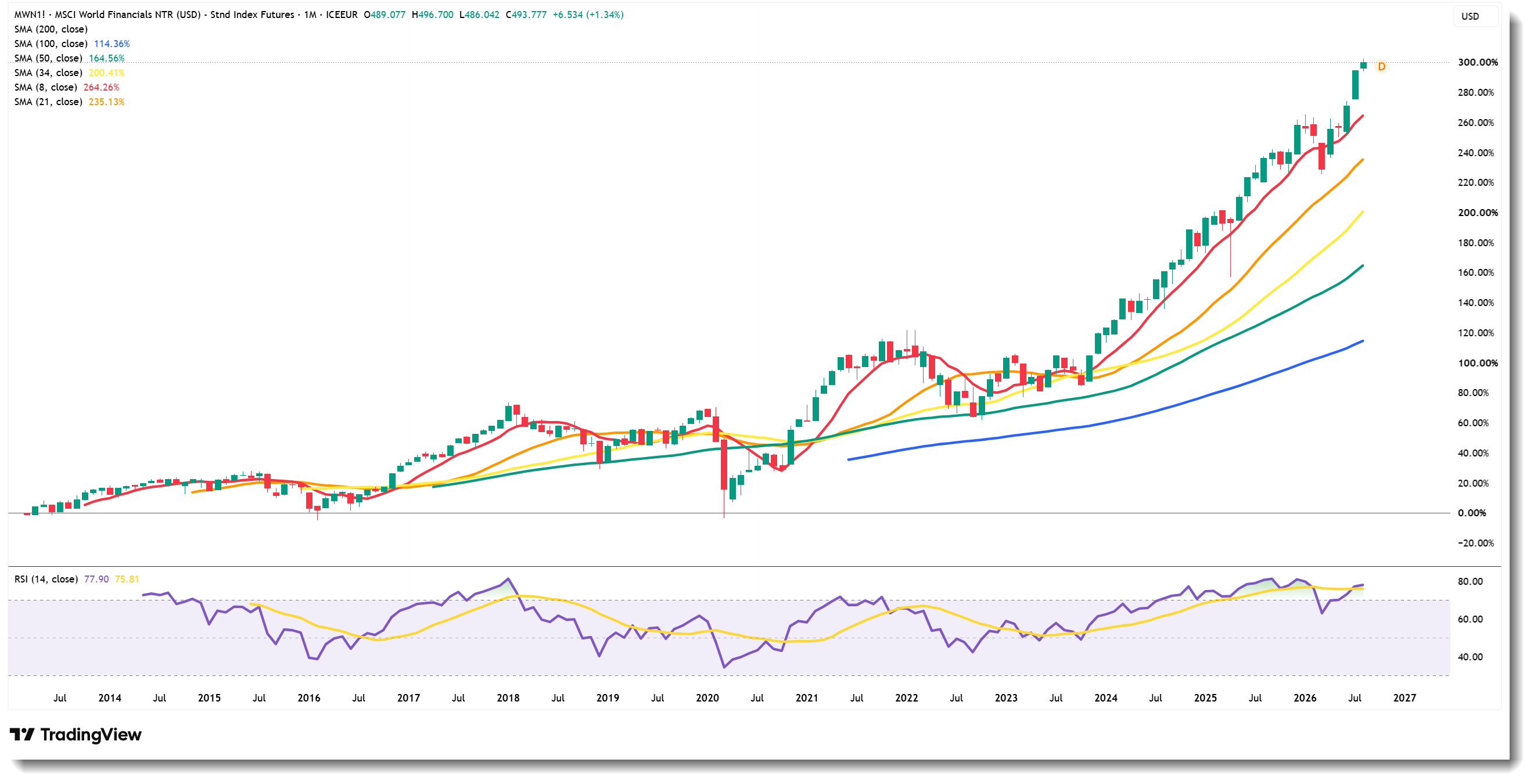
On average, they are trading at about 2x trailing tangible book value and 12x forward earnings. Surely ‘🐿️20-for-20’ should have a full serving of that alongside all of those ‘bottleneck’ stocks and robot picks.
Yet 20 years on, who knows if the AI circular financing merry-go-round will catalyze another global credit crisis - the comparisons between data center leases and adjustable-rate mortgages are certainly offering up a rhyme.
We of course need to consider our bank picks for 2046 in the context of that ‘AI economics don’t math’ scenario - however, arguably the worlds of ‘Intelligence Abundance’ and ‘Fiscal Dominance’ are even more of a threat.

In a world where AI agents are shopping for deposit rates 24/7 what value should you place on deposit franchises? On the other side of the NIM equation, are sovereigns about to force-feed negative-real-return rates paper onto bank balance sheets - like a foie gras goose farmer?
This threat is possibly not existential - banks are a vital cog in the mechanics of financial repression - they must be allowed to survive. There is probably a put embedded within the equity value of the SIFIs. If so, the put comes at a cost to right tail outcomes (regulated ROE corridors? dividend mandates?). In any event, plumbing, regulation and trust moats should provide some protection to the bankers from those relentless AI bot swarms.
The last 5 years have seen global banks deliver remarkable equity returns with bond-like volatility. Can they truly be the steady compounders we need for 🐿️20-for-20 portfolio?
Dealing with that Bot / Goose Farmer Pincer Move
Let’s start with the bear case…
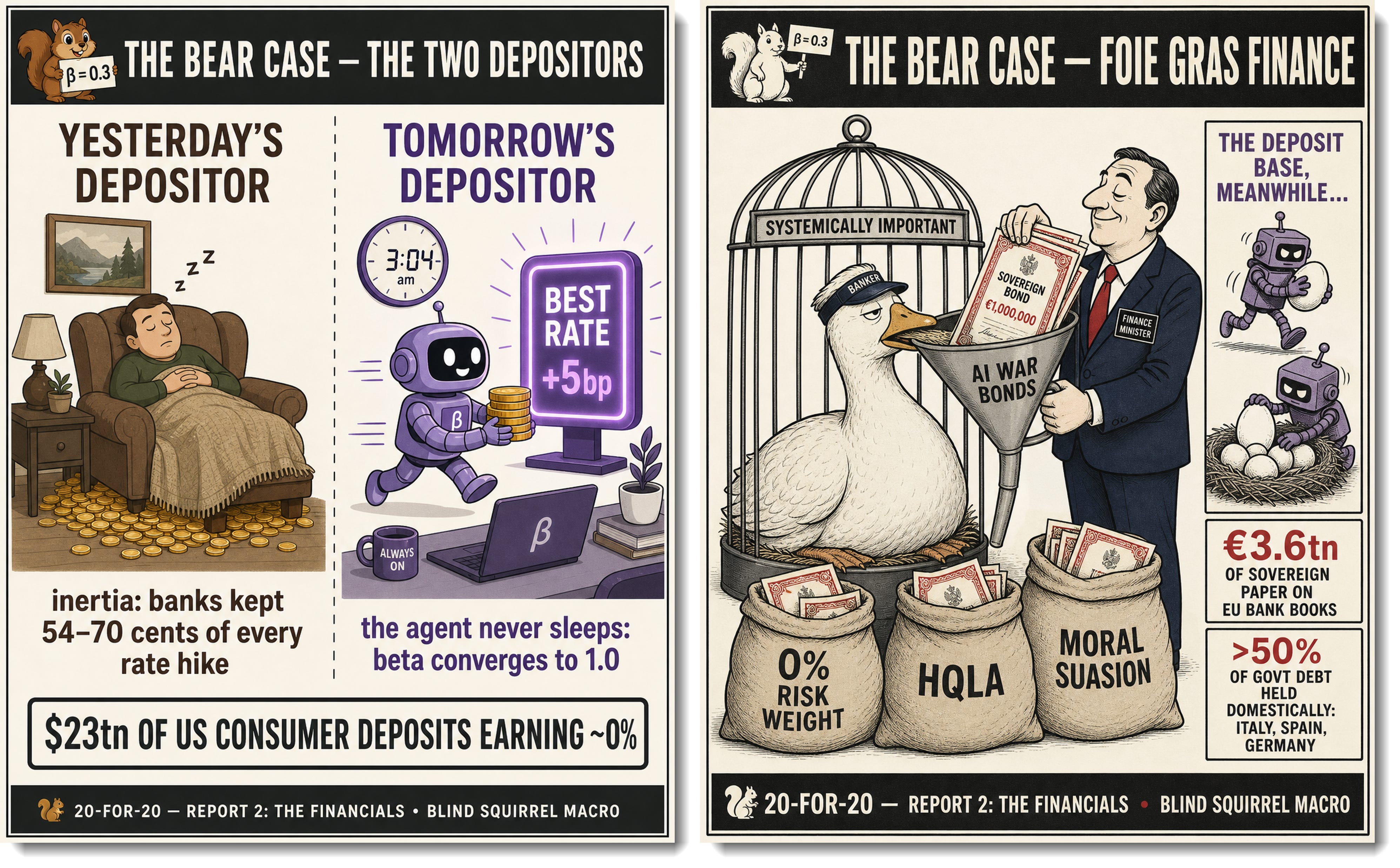
A bank’s deposit franchise is the present value of earnings from low-cost, stable funding (less servicing costs). The dirty little secret is that most of that value comes from retail depositor inattention and inertia. Most savers view filling in reams of forms for a few extra pennies of interest as poor cost/benefit.
Floating rate mortgages are adjusted within minutes of a rate hike. Capturing the same rate pick-up as a saver is a painful process of shopping around. Historically banks have only passed on 30-40 cents of every rate hike dollar to depositors. And we are talking about time deposits here, not checking accounts.
It’s not hard to imagine that many of us will soon have an AI personal finance bot that accurately forecasts how much cash you need in your checking account and constantly scans for better rates, transferring funds automatically.
Banks have invested a fortune in their digital offering to create stickiness via UX/personalization. The agents that become the interface of personal banking will not be wowed by the flashy app, they will just robotically plug into the API in the constant quest for a better rate (and they complete the form in a micro-second).
On the asset side of the balance sheet, finance ministers around the world are assembling a myriad of capital adequacy / risk-weight rules and plumbing facilities that pave the way for what many see as inevitable - the moment when, via suasion or coercion, banks become critical funders of deficits. “AI War Bonds” coming to a movie theater near you soon.
EU banks already sit on €3.6 trillion of eurozone sovereign rates paper. Domestic financial institutions already own more than half of the government debt stock in several major eurozone economies. The sovereign exposure of Italian banks is over 100% of core capital.
Now for the bull case with respect to that pincer...
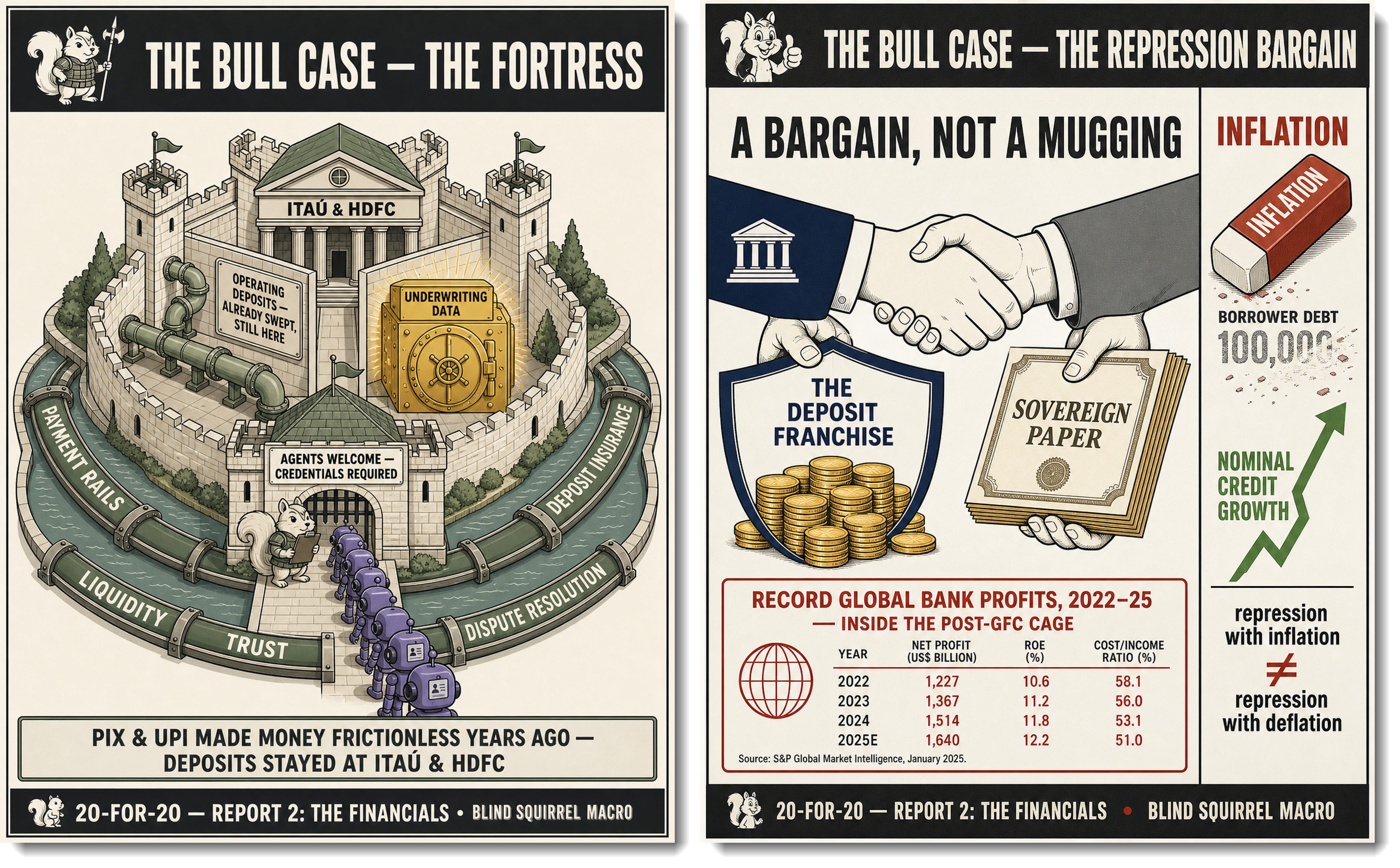
That bundle of payment rails, deposit insurance, liquidity, dispute resolution and habit / brand / trust is something that agents cannot replicate. Larger corporate and institutional depositors already employ automatic cash sweeps into money-market funds. JP Morgan, HSBC and BBVA’s corporate treasury customers will likely remain sticky.
Forward thinking banks are already beta-testing agentic sweep products for retail savers and SME depositors. Of course some cash will never move - Pix in Brazil and UPI in India made money movement frictionless years ago but cash deposits stayed at Itaú and HDFC.
However, in a world where cash pricing becomes transparent, credit costs become the key input to banking margins. The value of underwriting data (proprietary repayment and cash-flow histories) appreciates - the bank with better data wins good borrowers at the agent auction while rivals get picked off.
Tough to make a financial repression bull case but at least repression with inflation (which is the 🐿️ case) is also far kinder than repression with deflation! As nominal credit grows, borrowers’ real debts erode, asset quality holds, and banks earn the (regulated) spread. A better credit story than equity story!
The windfall in a financial repression world gets delivered to the banks’ capital markets and flow businesses. Nice to have, but most of that margin needs to be passed on to the capital markets bankers with their fast suits and winning smiles!
Owning banks in this world comes down to underwriting a valuation. The trouble is that most of the world’s most defensive franchises (think JP Morgan, UBS or DBS) are already trading at elevated multiples. A bank at 3x Price/Tangible Book carries more multiple risk than credit risk. Can buying here really deliver compounders for the 🐿️20-for-20 portfolio?
Last week’s introduction report for the 🐿️ 20-for-20 was free for all readers. If you would like to join us on the rest of the journey, please consider becoming a paid subscriber. Click the button below to claim a 30% discount (worth $135) on an annual subscription. OFFER MUST BE CLAIMED THIS WEEK!
Let’s pick some stocks!!…
Just as well that ‘Financials’ are not just Banks
In addition to banks, our long list of financials candidates also contains insurers, exchanges, asset managers and asset owners such as Berkshire Hathaway, Markel, Canada’s Fairfax and Sweden’s Investor. At the end of the process, we will need to be careful about how we treat these holdcos (if picked) in the context of portfolio sector and risk clustering caps.
Ultimately my key guide will be to classify selections on the basis of what kills them in a crisis but we will make the call at the end of the 🐿️20-for-20 portfolio construction process.
