



Time for something completely different. Am riffing on an idea that my old friend Paul Krake and I worked on about 10 years ago. Picking 20 stocks for 20 years may be about as challenging as visualizing the middle America of 2015… as the makers of ‘Back to the Future II’ did in 1989.
But we are not attempting that - it needs to be a portfolio that works whether we have hoverboards and live in an AI-enabled utopia in which human aging and fusion has been ‘solved’ - or instead something like ‘Mad Max: Beyond The Thunderdome’, ‘Elysium’, ‘Rollerball’ or ‘The Hunger Games’ is more the vibe.
A rare paywall-free edition of Blind Squirrel Macro this week. If you like what you read and want to follow the rest of the journey, why not get in touch with the 🐿️ to claim a free trial or share it with a friend or colleague.
Report 1: The Mission
“It’s tough to make predictions, especially about the future.” – Yogi Berra
Over the next few months, the plan is to construct a 20-stock portfolio designed to own for the next 20 years (“The 🐿️-20-for-20”). I plan to do this with all workings on show in a step-by-step sequence of reports between now and late November. Many of the single stock debates will get a segment on the Benny and the Squirrel Sunday shows.
This gradual pace is deliberate. We are in a mid-terms year and there are some meaty questions about the dominant AI narrative that will get an explicit answer from the market in the coming weeks. I suspect we are going to learn a great deal from the Anthropic IPO process…
My intention is to get to a place in which 🐿️-20-for-20 will become a dedicated sleeve within the BUSHY™ portfolio. That beta portfolio will continue to capture my macro biases and hard asset centricity but I want to have a core equity component that is focused on a bias-free uncertain horizon.
If a gold miner makes it into 🐿️-20-for-20, it will be because it survived the same selection gauntlet endured by automation companies, reinsurers and hyperscalers. The portfolio will undoubtedly contain stocks that require this rodent to ‘hold his nose’ when buying them.
The Challenge and Founding Principles
Modern markets are dominated by passively managed flows and a dispersion trade that is exacerbated by ‘pod shop bros’ trading the next quarter. The only question that I want to try to answer is what combination of today’s listed companies will leave 🐿️-20-for-20 in a good place in 20 years’ time.
The critical test for 🐿️-20-for-20 is not to make a definitive bet about what 2046 looks like. No crystal balls on offer here. The disaster outcome would be to pick 20 CUSIPs that are essentially the same trade wearing different wigs - even if that trade miraculously worked, it would be a fluke. This is an exercise in deliberate diversification with respect to macro / thematic outcomes.
Some basic ground rules.
The 🐿️-20-for-20 will contain stocks based on a mosaic of potential states of the world in 2 decades time.
The founding 🐿️-20-for-20 book will only contain genuinely profitable (on a true GAAP basis - no voodoo adjustments), cash-generative and self-funding businesses.
The portfolio will be global - with hard caps on both geographical and sector exposures.
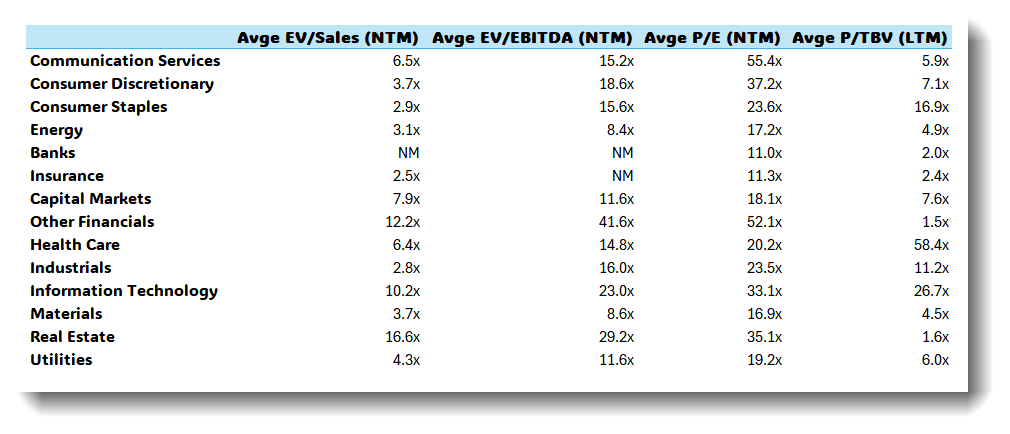
Valuation matters. Even if I believe that a durable franchise will still be dominant in 2046, then paying the wrong price for it in 2026 will damage compounded returns. (No pre-judgement, but I am guessing that Walmart and Costco ain’t making the cut based on their current multiples - and I thought that ahead of WMT 0.00%↑’s sales growth numbers last week).
The portfolio will be equal-weight ‘at birth’. We will of course let our winners run within reason - but there will be some risk management / portfolio concentration over rides.
On an ongoing basis, the primary test for cutting a stock from the book will be a clear break of the initial thesis related to one or more of the macro outcomes - not just as a result of a (hopefully temporary!) drawdown. There will be no mention of micro catalysts when underwriting 🐿️-20-for-20 stocks.
This one is a tough one for the rodent. I do not plan to employ any technical analysis in selecting stocks for🐿️-20-for-20. As you know, I am a big believer in charts for trade selection and risk management - I am just not convinced that enough market participants are looking at stocks with a multiple decade lens such that they would be ‘leaving a mark’ on the tape today. Chart breaks will of course be an invitation to thoroughly ‘red team’ the initial thesis.
Avoiding (Theoretical) Mistakes of the Past
Am taking my mind back 20 years to 2006. How would I have processed the same intellectual exercise back then?
China has been in the WTO for 5 years - fixed asset investment there is growing at 25-30% per year and Goldman Sachs preaches that the future is BRICs.
Crude oil is above $70 and the “peak oil” narrative is mainstream.
Mobile telephony was the ultimate ‘GARP’ (growth at a reasonable price) play.
US home prices have never fallen nationally as long as modern data has been collated.
Financial stocks represent 23% of the S&P - and they are absolutely CRUSHING it!
The iPhone does not yet exist. Amazon launched a data storage business 5 months ago but it’s niche. Nvidia is a graphics card company that acne-ridden gamers think is cool. Tesla might (maybe) ship an EV in a couple of years time.
Full disclosure: In August 2006, I was a few months away from being made an MD at Citigroup. I was a busy investment banker - not blogging in Mum’s basement about sub-prime mortgage risks. I was a ‘time poor’ young parent (hugely slightly resenting missing out on the bull market that was raging in Chinese equities) and a commodities believer spending way too much time with the ‘financial sponsor’ community (later renamed more grandly ‘Private Equity’) trying to figure out if markets would support yet another turn of leverage.
Where on earth do you think my long-term stock outlook was with that backdrop?!
What equal-weight 🐿️-20-for-20 portfolio would I (honestly) have constructed in 2006? I think it would have probably looked something like this:
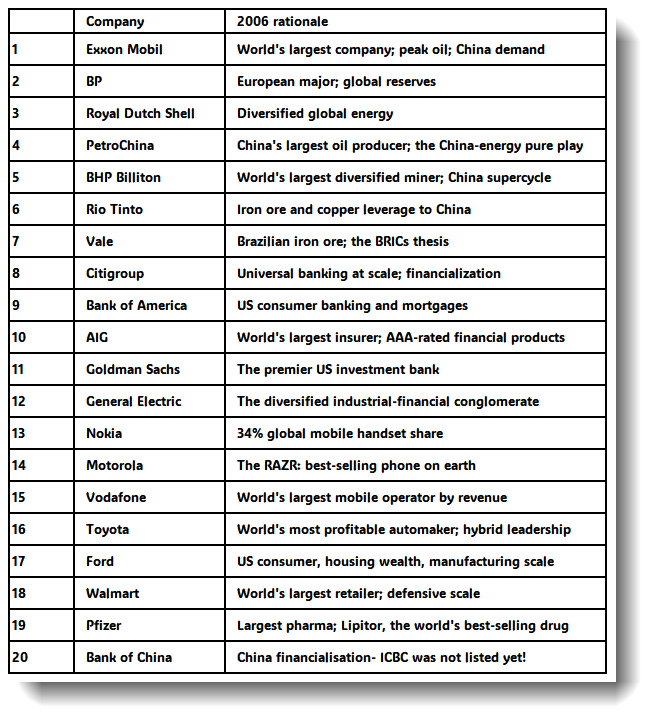
Anyway, a $100k investment in that portfolio would have turned into a ‘creditable’ $399k today - i.e. compounding at just below 7.2% per annum having stomached a 10 year drawdown between 2008 and 2018.
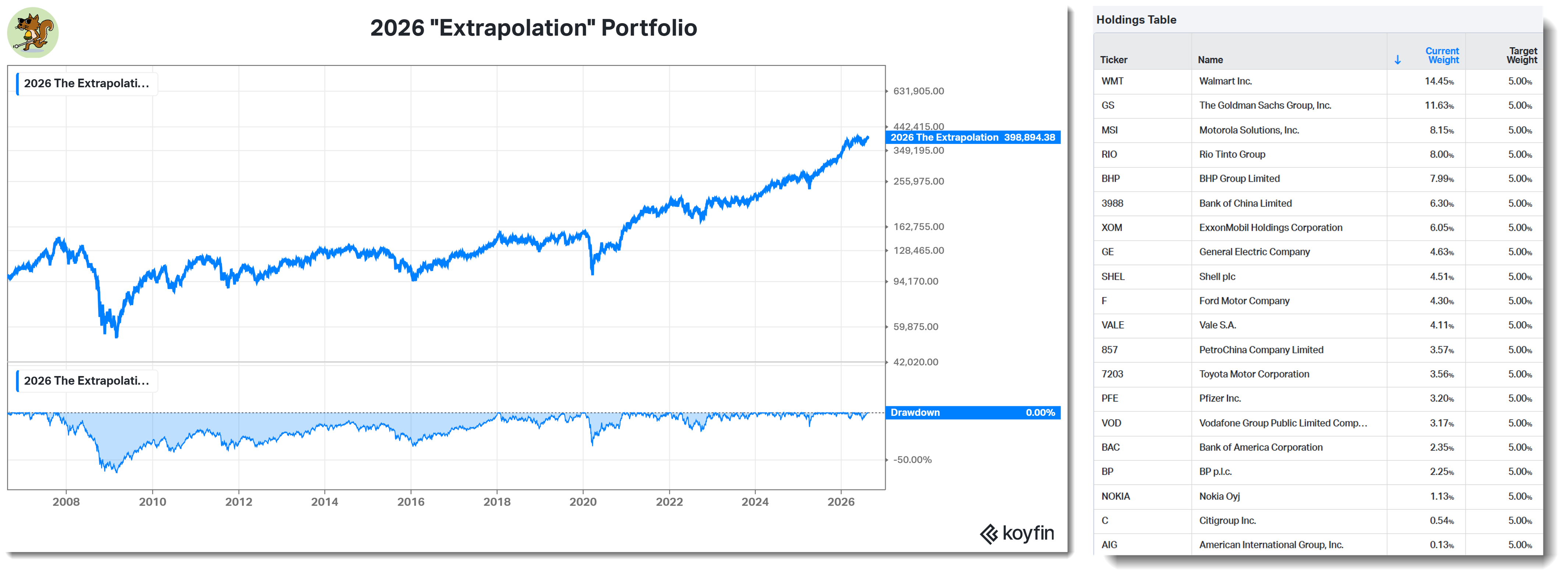
What if I had taken a step back from the narrative ‘extrapolation’ portfolio and had not made assumptions based upon the world staying the same? What questions should I have asked myself?
About the central narratives…
What do I own that only works if China, oil, housing and credit all keep compounding?
Which of my “diversified” positions are actually different expressions of the same trade hiding in different CUSIPs?
About each holding…
Does this business survive a credit crisis or violent business cycle turn without asking the market for money?
Where does the profit pool sit in this industry - and what stops it from migrating to a different place? What is that different place?
What kills this business and how would I be able to spot that risk early?
Was I re-underwriting valuations at levels too high to allow me to compound capital?
About the portfolio as a whole…
What am I not exposed to, and what world would make that omission costly?
What do I own that makes money if the world gets worse rather than better?
Which of my “defensive” names are actually leveraged to the same cycle as my “aggressive” ones?
About myself…
Am I extrapolating the last five years because the evidence supports it or just because it has worked?
What would I own if I assumed the next twenty years look nothing like the last twenty?
If my business and my portfolio all depend on the same regime, have I diversified anything at all? This last point is a form of confession - in 2006, my career was the extrapolation portfolio!
The questions that would have built the Mosaic
When computing spreads into everything, who collects the rent?
When the world needs more chips - for anything - who claims a piece of that value chain?
When two billion people join the cash economy, what do they buy first?
When labor or energy get expensive, who sells the machines and other tools of efficiency?
When everyone is a forced seller, who has the cash to buy the bargains?
I am trying to extract hindsight as much as possible (it’s hard!). But I like to think that a 35 year old 🐿️ that was asking the right questions would have come up with the following ‘mosaic’ portfolio. Hindsight Capital LLC is always a ‘Hall of Famer’ - $100k in the 2026 Mosaic portfolio compounded at 19.4% and is now worth $3.45m!
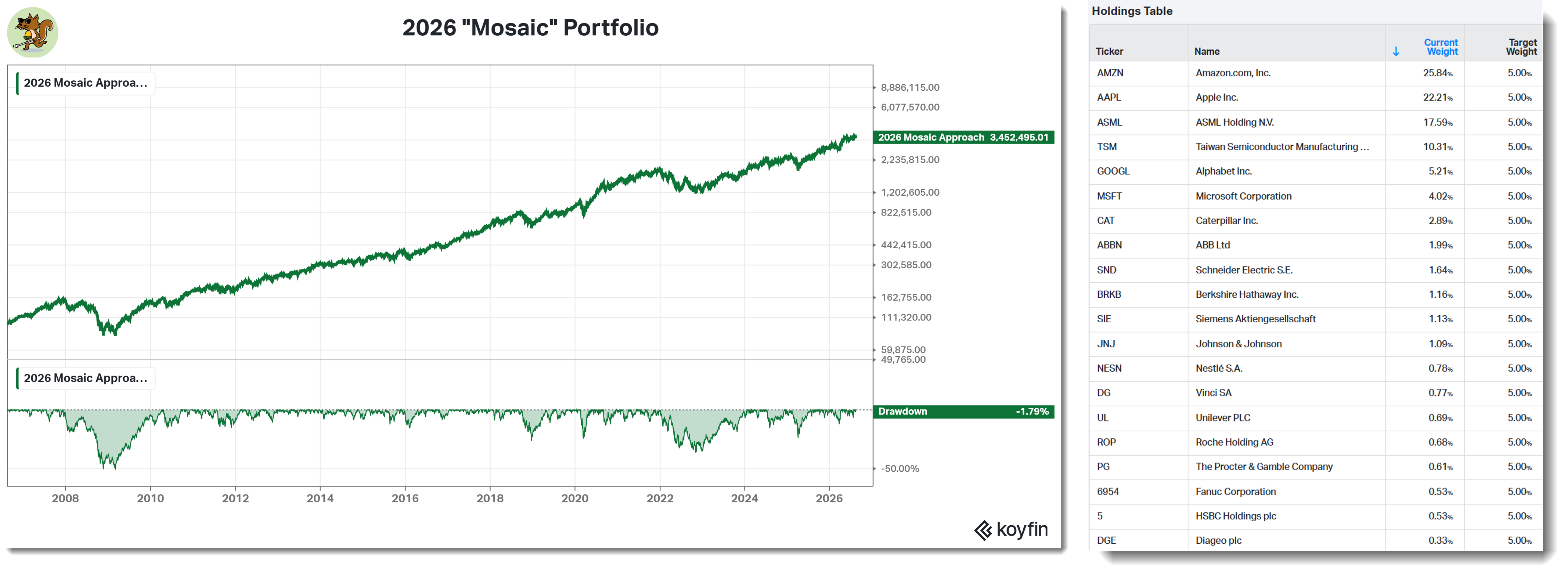
With such a degree of foresight, the Mosaic Portfolio - having ditched its GFC drawdown within a couple of years - would have delivered (fantasy!) returns that would have left US stocks (S&P), global stocks (ACWI) in the dust and 8.6x (!) those of the lowly Extrapolation Portfolio.
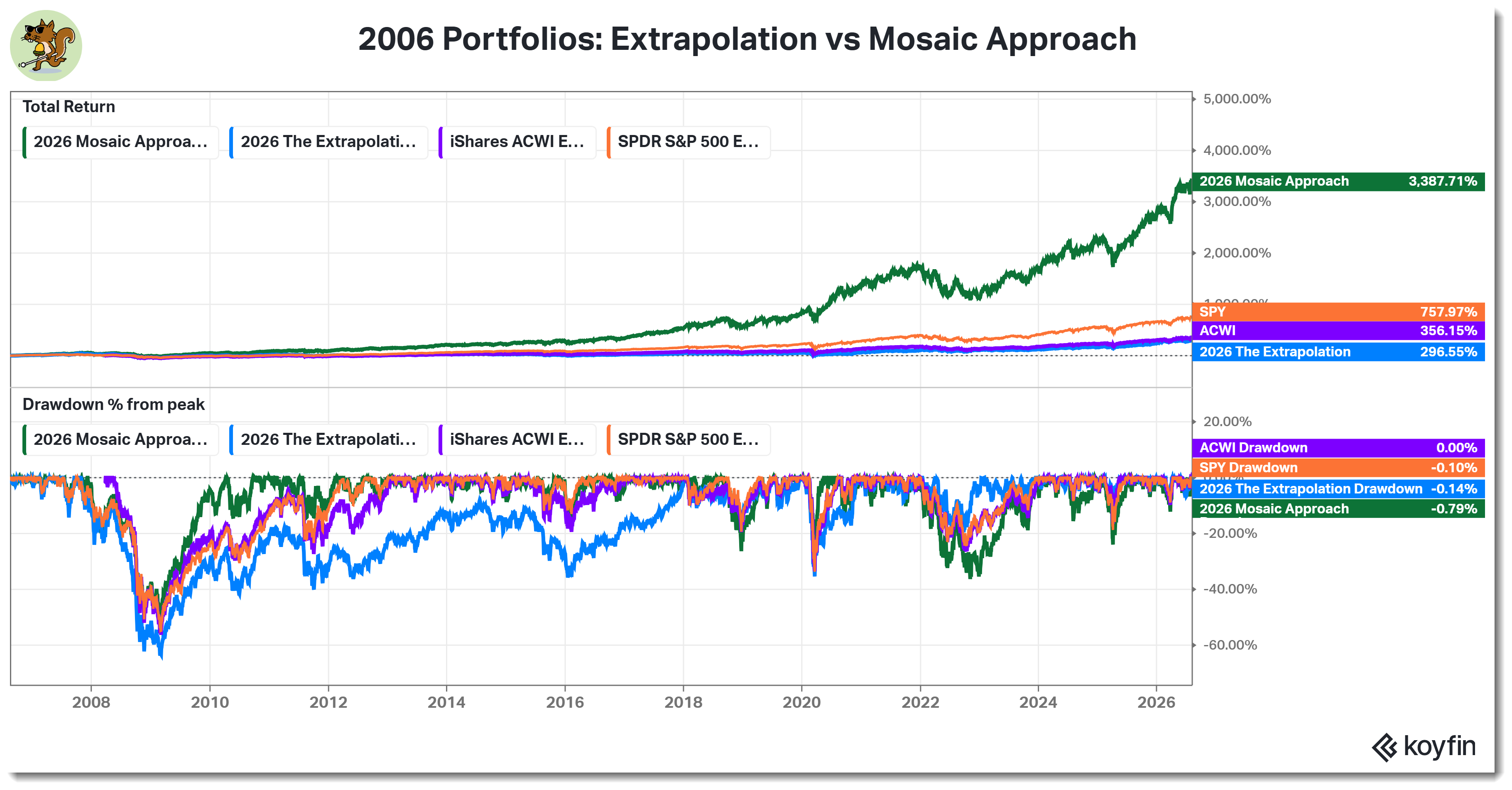
Of course, the Mosaic portfolio looks like a classic case of what the quants like to call “fitting”. Actually, even the Extrapolation portfolio got a kicker from “survivorship bias” (this is because Koyfin only allows me to construct model portfolios incorporating stocks that still exist today).
Realistically, risk management would have likely compressed both tails. A sensible drawdown protocol could have avoided the worst of the losses in AIG, Citi and Nokia.
Note that a simple process of annually rebalancing the Mosaic portfolio would have cut its 20-year total return in half. Conversely, annual rebalancing would have added 50% to the returns of the Extrapolation portfolio. Nevertheless, even if I am a big believer in letting winners run, I am pretty sure that I would not have allowed three stocks (Amazon, Apple and ASML) to have become over two-thirds of the book.
Is this Mosaic approach a repeatable exercise?
I think so. Probabilistic thinking was available to anyone back in 2006. It was just about asking questions. What would happen to my portfolio if China (inconceivably) slows down, if oil supply were to somehow respond, if house prices were to mean-revert and financial leverage unwind?
What if the mobile telephony profit pool moved from carriers and hardware to software? You did not need to predict the iPhone, but ‘backing up the truck’ on Nokia was probably going to be a bad idea.
Similarly with Amazon. I was in no position to predict that AWS would become the 800 pound gorilla of cloud computing. However, the ‘hot’ online retailer was growing; had been GAAP profitable since 2003 - and its newly launched business line made sense and was 100% internally-funded.
The point is that the process of actively avoiding a book that is thematically concentrated increases the likelihood of stumbling upon winners ‘by accident’.
So, what are today’s key questions?
Today, the 2046 Extrapolation portfolio easily constructs itself - you would probably end up with well over half the book in AI and AI-derivative / supply chain names, supplemented with a couple of nods to the GLP-1 obesity economy and deglobalization. The 🐿️ wants to try and avoid that trap.
I have come up with a mosaic of 10 core themes for the next 2 decades.
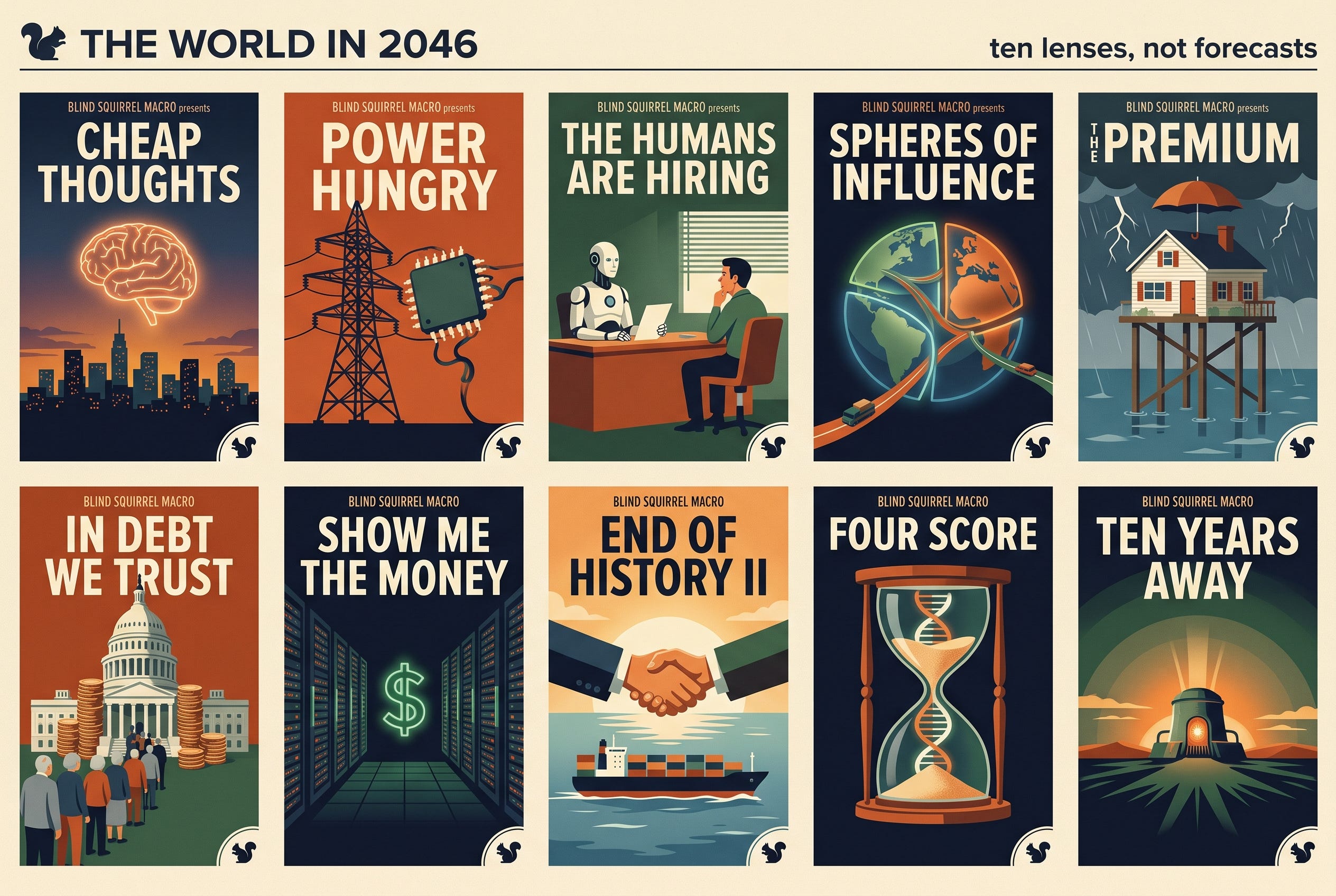
Importantly, they are lenses not forecasts and several can be true at once. I want to score every stock in the 🐿️-20-for-20 portfolio against these themes. A company that works in multiple scenarios is attractive. A company that only thrives in one version of 2046 can qualify but it would need to truly dominate that version.
Intelligence Abundance: If ‘digital cognition’ becomes cheap, who owns the distribution, trust, data and the right to act? Who suffers?
Constrained Physical Capacity (aka ‘The Bottleneck Bros’): If compute demand outruns power supply, grid and chip capacity, which members of the supply chain win? Who cannot keep pace with the prices paid by the AI spenders?
The Robot Age: If physical AI scales, who captures the productivity margins - is it the makers, the integrators or the owners of workflow? Whose pricing power gets vaporized?
The Multi-polar Geopolitical world: If deglobalization accelerates and trade flows re-route, who owns the trusted capacity? Who are the connectors? Who are the geopolitically exposed exporters?
The Climate Threat: If climate becomes a balance sheet problem, who sells resilience? Who picks up the biggest bill?
Debt, Ageing and Fiscal Dominance: Which companies can compound in a world in which the state is the dominant debtor, customer and regulator? Who gets crowded out of funding (and other) markets?
AI Economics don’t math: If AI monetization disappoints, which companies still generate cash?
Francis Fukuyama was right after all: If global trade and integration somehow endure (The End of History), which companies benefit from the world working ‘as normal’? Which companies are over-earning on the spoils of protectionism?
The end of “Three Score and Ten”: At 55, the Bible would have us believe that the 🐿️ would have a limited chance of being around to see which 2046 outcomes play out! What if scientific advancement cracks the code with respect to (productive) human longevity? What if that code is shared unequally?
Energy Revolution: Commercial and abundant fusion or geothermal energy have been ‘10 years away’ for most of my life. If it finally happens, owning Canadian oil sands assets in size will be a tough day in the office but who else loses (and wins)?
Making it Systematic
I already own a bunch of single stocks which my discretionary brain is probably wired to consider for automatic admission to 🐿️-20-for-20 portfolio. Surely Glencore is a ‘no brainer’ right? Yes - even my favorites will be subjected to the same systematic scoring system.
Resilience and Fragility Score
I am going to score all candidate stocks against the 10 mosaic themes (on a scale of +3 to -3) to create a blended score.
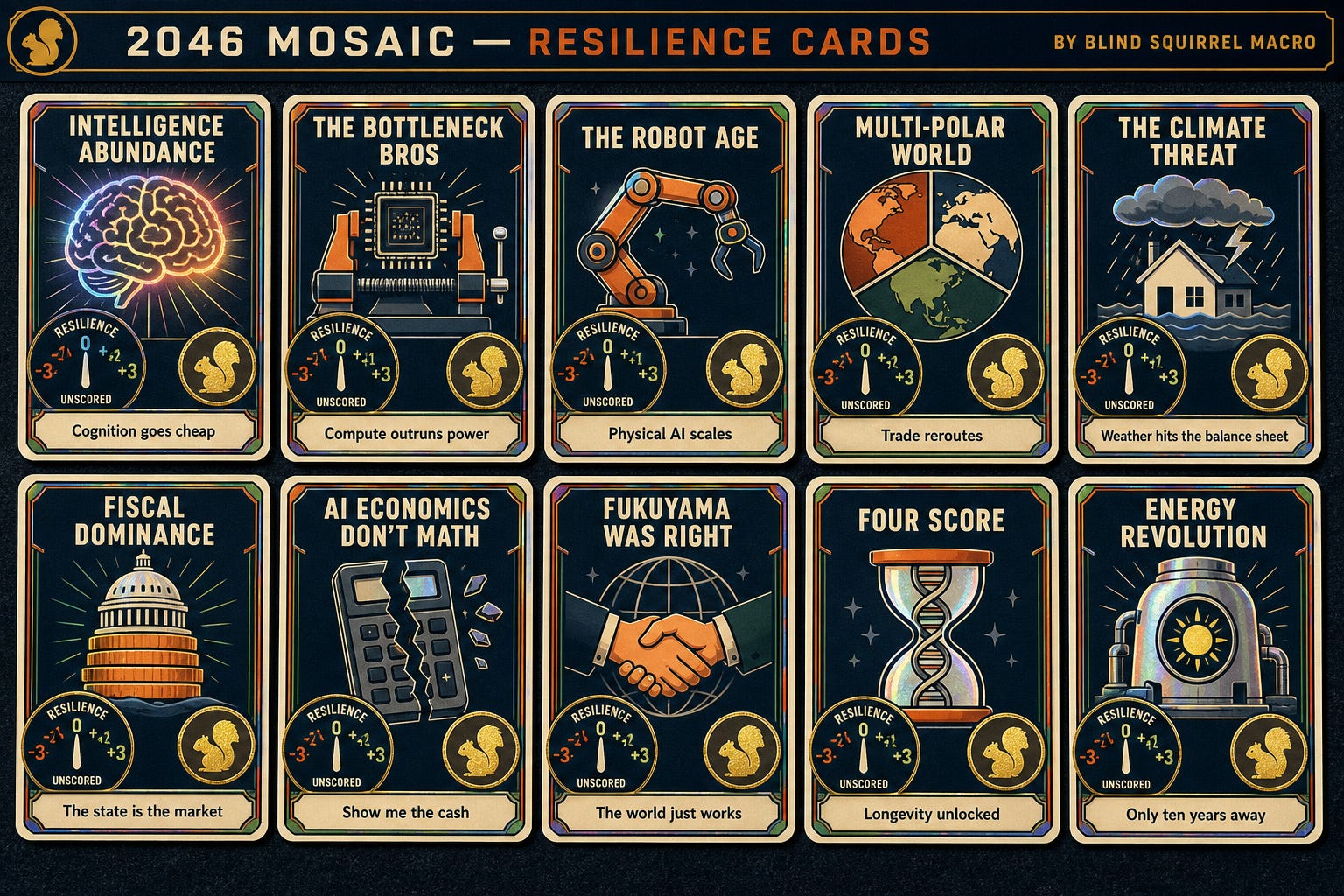
The goal is to identify winners across multiple regimes and to be very wary of names that get wiped out in one (or more) 2046 scenarios - the 🐿️-20-for-20 portfolio can only tolerate one or two of these names. Scoring ‘-3’ on two or more themes probably demand automatic exclusion.
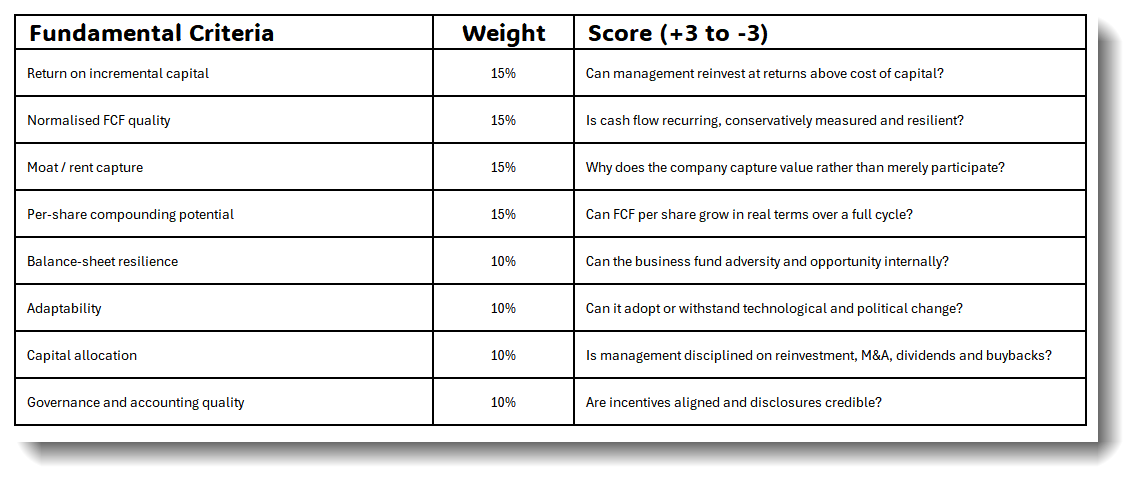
Fundamental Quality Score
Next we will screen on the basis of 2026 fundamentals. This process may well claim a few high profile scalps.
Valuation Score
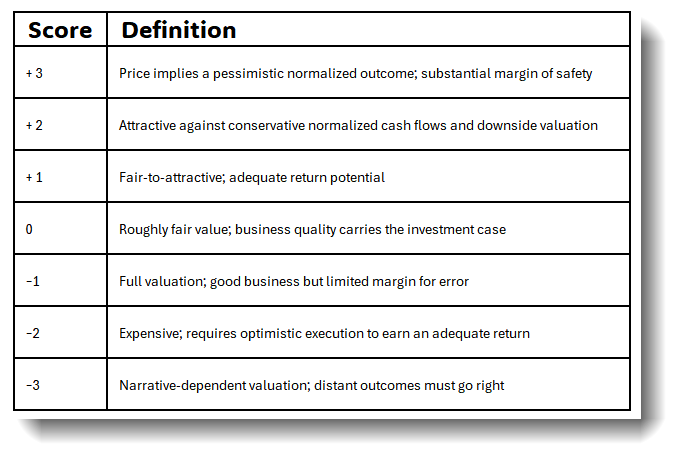
After resilience and fundamentals comes valuation. These stocks don’t just need to survive 20 years, they need to deliver attractive returns to the book.
Portfolio Risk Score
Initially I want to cap single sector exposure at 25% and single country exposure at 40%.
However, after scoring stocks at the individual level, the 🐿️-20-for-20 portfolio draft will then be reviewed for ‘risk clustering’ around the key macro themes set out below.
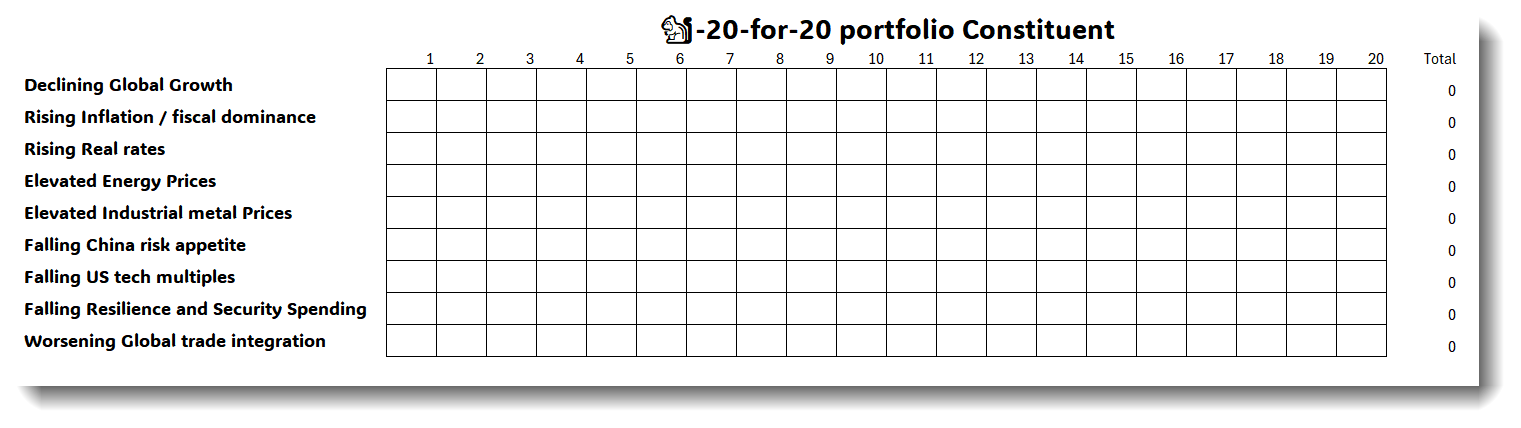
Clearly there is some overlap / inter-relationships between these risk clusters but I want to be eyes wide open as to the risk to which the portfolio is potentially over-exposed.
Early Underwriting
I have already done some initial screening. In a concession to efficient market theory, I added the 65 largest companies from the key geographical regions to the list of around 60 stocks that I had short-listed - on a subjective basis - based on their resilience to our 10 ‘2046 macro mosaic’ outcomes.
All 125 stocks - with $58 trillion of aggregate market cap - will be put through the screen if they satisfy ‘Test 1’ of being genuinely profitable today on a true GAAP basis, with none of those voodoo adjustments (including adding back stock-based compensation to earnings).
Given the 🐿️-20-for-20 portfolio’s 40% single country and 25% sector exposure caps, it is unlikely that the final set of stocks will look much like the pie charts below.
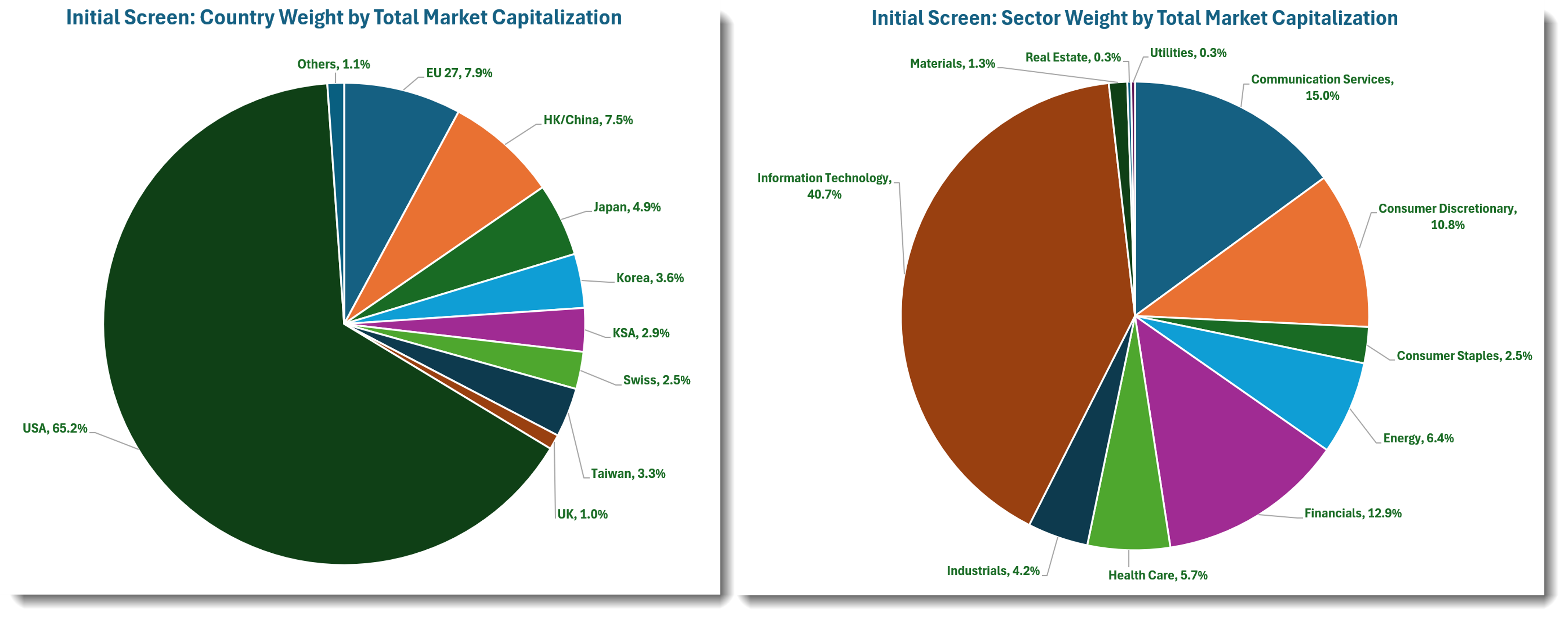
I suspect that the valuation screening exercise will take care of a lot of the pruning.
The Game Plan
The hard work starts now. The initial long list can be downloaded below. Let me know if you think there are any obvious missing names.
I am happy to put sensible suggestions through the screening / risk underwriting process. Any reader that is first to name an individual stock not on the long list into the final 🐿️-20-for-20 portfolio will get a lifetime free subscription!!

The first group to run the gauntlet of the screeners will be the financials (extracted below):
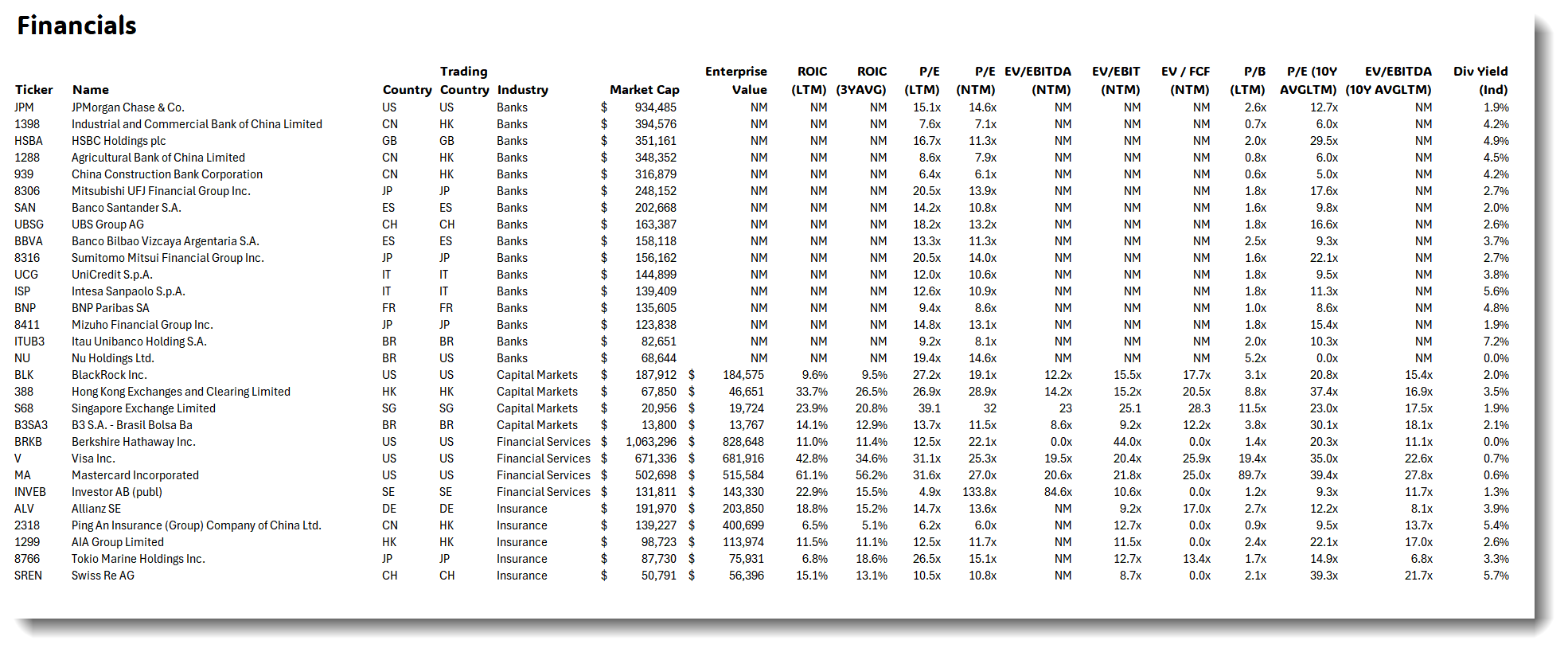
Unlike industrial or tech companies that can pivot products, financial institutions are bound to the worlds of capital, credit, and trust. In this sector, we are not trying to predict the next fintech revolution or to solve for the cheapest banks on a price-to-book basis.
We are looking for institutions that can survive across multiple - often contradictory, future states of the world:
What if AI monetization disappoints but payment rails remain essential?
What if fiscal dominance turns traditional banks into utilities but creates demand for inflation-hedged assets?
Which insurers will get longevity and climate risk right?
What if deglobalization fragments capital flows but rewards trusted intermediaries in neutral jurisdictions?
The 20-year horizon demands that we focus on the structurally resilient players. I suspect that we will need to hedge our bets geographically. The 🐿️’s job for next week!
Dear Free Subscriber - You made it to the end! Thank you for reading. If you want to follow the rest of the journey, why not claim a free trial by hitting the button below.
Do get in touch if you have any questions.
Until next time, Squirrel Out!
If you act on anything provided in this newsletter, you agree to the terms in this disclaimer. Everything in this newsletter is for educational and entertainment purposes only and NOT investment advice. Nothing in this newsletter is an offer to sell or to buy any security. The author is not responsible for any financial loss you may incur by acting on any information provided in this newsletter. Before making any investment decisions, talk to a financial advisor.
Extraction of energy and materials is front and center in any future view. Processing seems to be an afterthought . Between Russian refineries being blown up by Ukraine and US refineries being shut down by environmental rent-seekers, processing capability is going down not up. For oil, I would put refinery investments over exploration investments. Guyana coming on line, Canada waking up to their economic issues and need to monetize what is in the ground. There seems to be plenty of oil, maybe not in the right spots NOW. But politics change. South American politics is certainly changing, and that could mean more extraction of metals. China is moving toward control of all processing of natural resources. And US/EU environmentalist will help them control oil also, at some point. How to play the processing bottlenecks if the raw materials shortages are being mitigated?
I nominate Agnico Eagle (AEM)