
Story so far: Report 1 outlined the goals and ground rules for the🐿️’s “20-for-20” portfolio. Report 2 tackled the global financials sector, leaving us with a shortlist of 9 stocks from that sector (of which we will get to keep 5 or MAX 6).
Atoms in Algo World
You already knew that the 🐿️ is a bit of a hard asset bull. Yet this is not a call to buy resource stocks indiscriminately. Rather it’s an attempt to identify the few resource businesses that can convert structural scarcity into durable (and fairly priced!) free cash flows across our mosaic of potential macro futures.
One of the key goals in constructing this portfolio is to learn from the ‘mistakes’ made by the ‘2026 Extrapolation Portfolio’. This imaginary basket of stocks not only added a generous slug of financials on the eve of the GFC but it also loaded up on energy and resource names just as China’s fixed asset investment boom looked like it could never end.
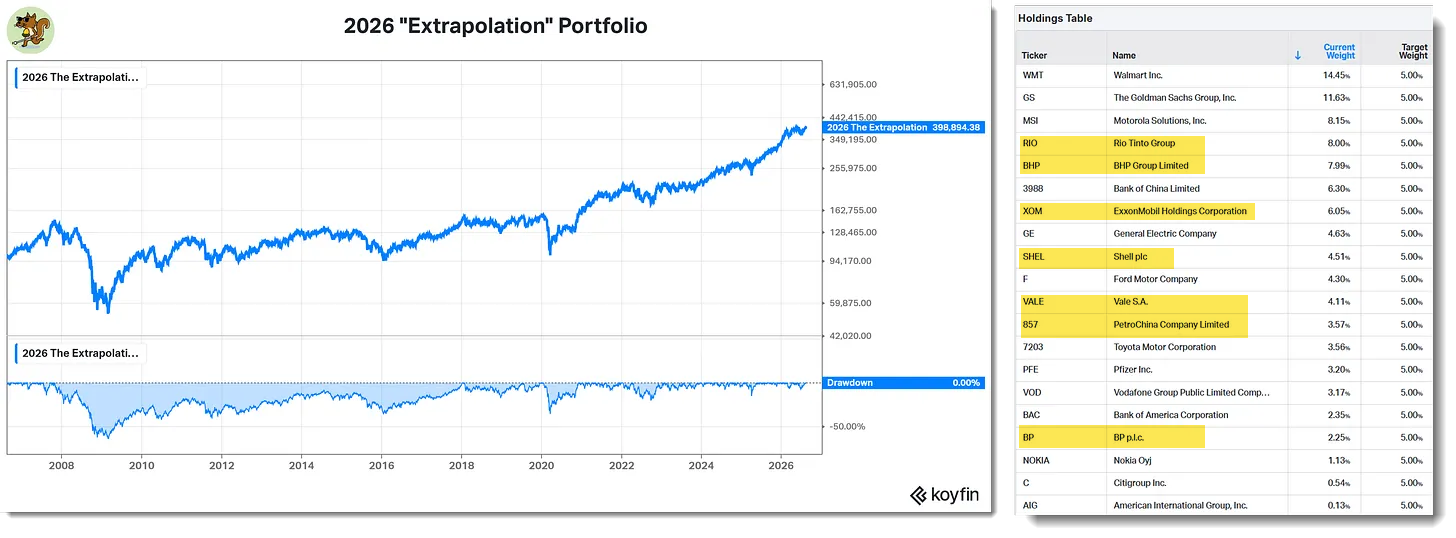
The fact that some of these names ended up making positive contributions to the portfolio’s total returns after 20 years (i) is flattered by the fact that the financials did so poorly and the mobile telephony margin pool migrated to the software giants and (ii) it ignores the fact that the two decade path to 2026 for resource stocks was dominated by a gut-wrenching drawdown.
The chart below shows 25 years of the CRB spot commodity index. The 100% run-up of commodities in the four years leading up to the summer of 2006 is the kind of chart that would have sucked in even the most resistant of momentum traders.
Of course DJP 0.00%↑ the ETN tracking Bloomberg’s commodity index was launched in June 2006! As soon as ETFs launch that track your favorite themes, it’s probably time to start looking for a new theme…
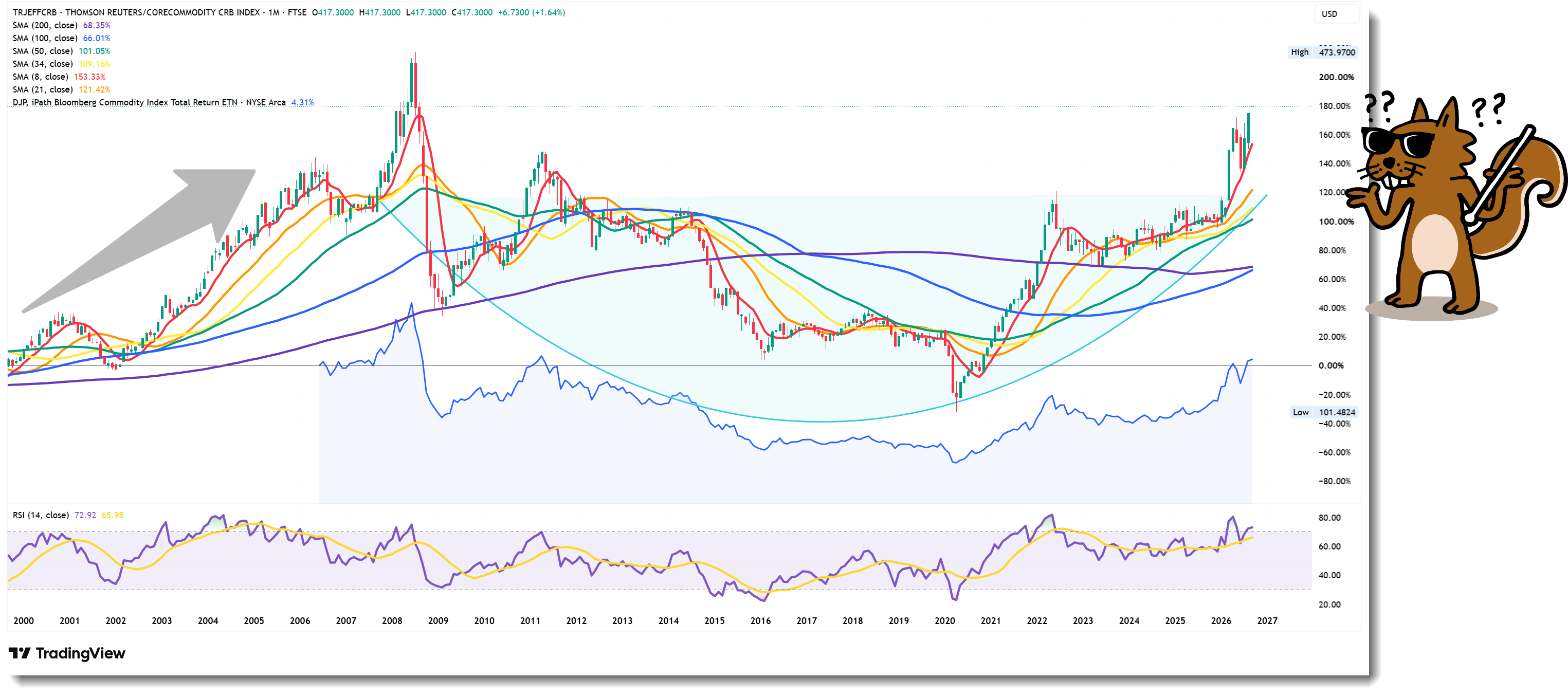
After peaking and then collapsing in 2008 and then offering a partial post GFC recovery, DJP’s total return since inception only turned positive at the beginning of this year! In normal times, roll costs massacre the total returns of buy and hold investors in many commodity futures - even if BNO 0.00%↑ is doing a pretty good job of harvesting roll yield in 2026.
Spot commodity returns, futures total returns, and equity returns from well-run producers are very different animals. The lesson here is (obviously!) not that commodities are un-investable in a long timeframe ‘buy and hold’ strategy.
Nevertheless, overweighting a cyclical theme at the moment it has become benchmark-dominant is very different from underwriting durable scarcity when it is still pretty much irrelevant to the broad indices.
Real Assets Must be Heard Louder
Back in 2006, Energy and Materials represented about 15% of the MSCI ACWI index. Energy alone doubled from a c.7% weight in 2005 to c.13% at the time of the 2008 oil spike. Today Energy and Materials are back to 8.3% of ACWI. Information Technology (plus Alphabet, Amazon and Meta) account for 4.4x that weighting.
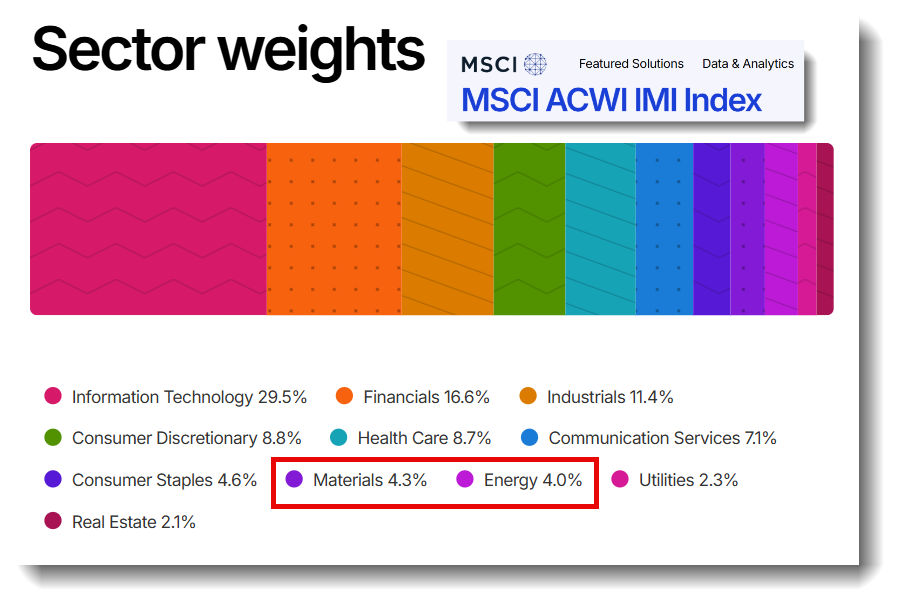
The 🐿️’s ‘20-for20’ portfolio will NOT be following MSCI’s benchmark. In my view, the current ACWI is the current 2046 Extrapolation Portfolio! My prior is that I expect that resources will merit as many as 5 of those valuable equal-weight slots. But they have to pass the same (thematic resilience, fundamental and value) screens as every other pick in the book.
The extrapolators of 2006 bought resource companies for growth - more tons, more barrels, more China. Resources are now a scarcity trade. We want to own them as a consequence of years of capex famine, the shortage of Tier-1 discoveries and the need for grids to be built out regardless of election (or AI) outcomes.
We also need to consider that ‘small’ matter of a monetary system whose debts likely only get resolved via debasement.
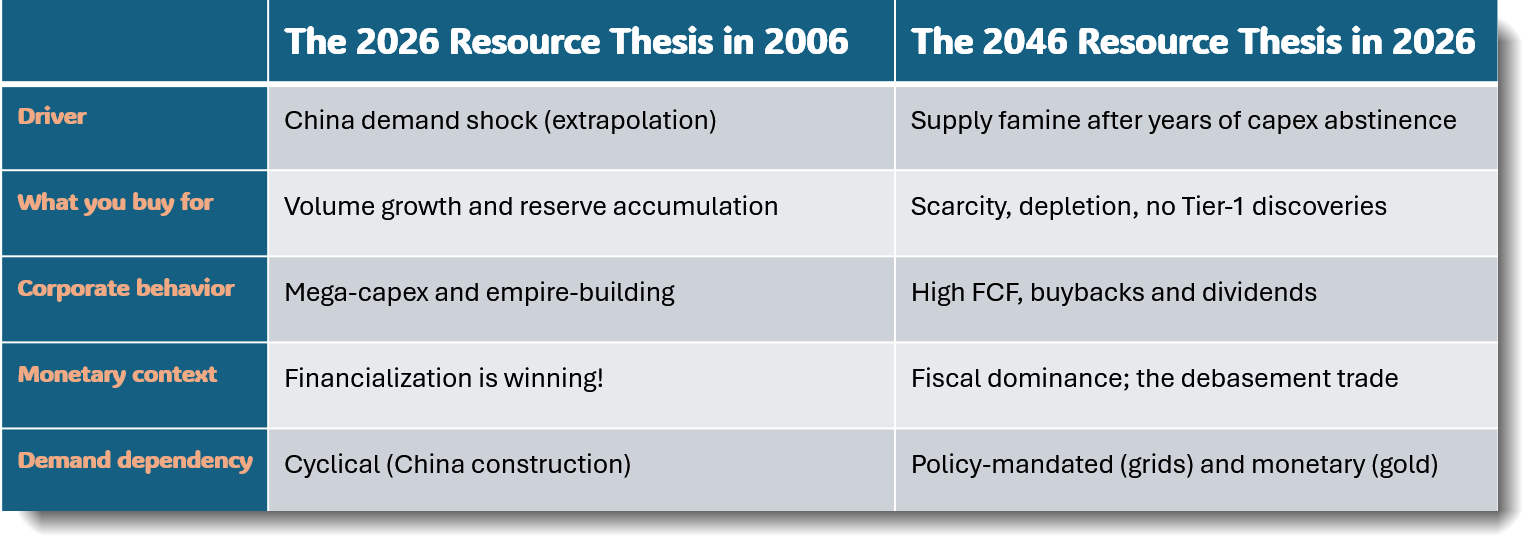
The motivations for an overweight position in resources today are completely different from those of the “Extrapolation Portfolio” 20 years ago.
A Lot Can Happen in Two Decades
Before getting to stocks, we need to think about where the first order impacts of the theme mosaic hit the various resource sub-sectors. We will screen our resource picks through the same prism as all other “20-for-20” stocks: that mosaic of 10 (potentially overlapping) macro states of the world in 2046.

No points for pointing out that the world of ‘constrained physical capacity’ (T2) represents forceful tailwinds for almost all sub-sectors…
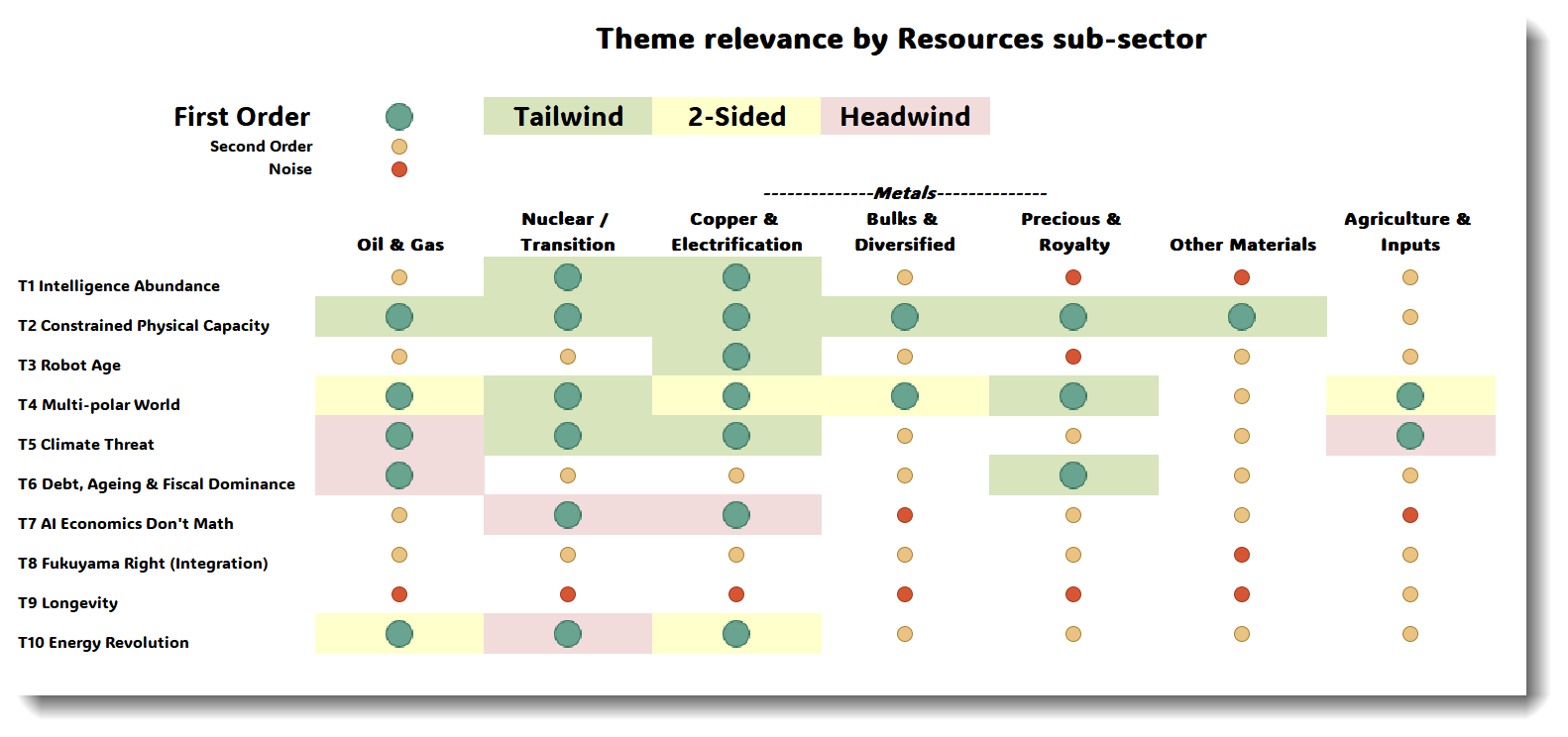
…however, there are interesting debates to be had:
The AI Question
In the world of cheap intelligence (T1), winning is defined by cheap electricity. The AI overlords plan to lean into nuclear and natural gas in order to satisfy demand. Data center builds and necessary grid upgrades are the bid under copper. But could this world already be ‘in the price’ of the stocks?
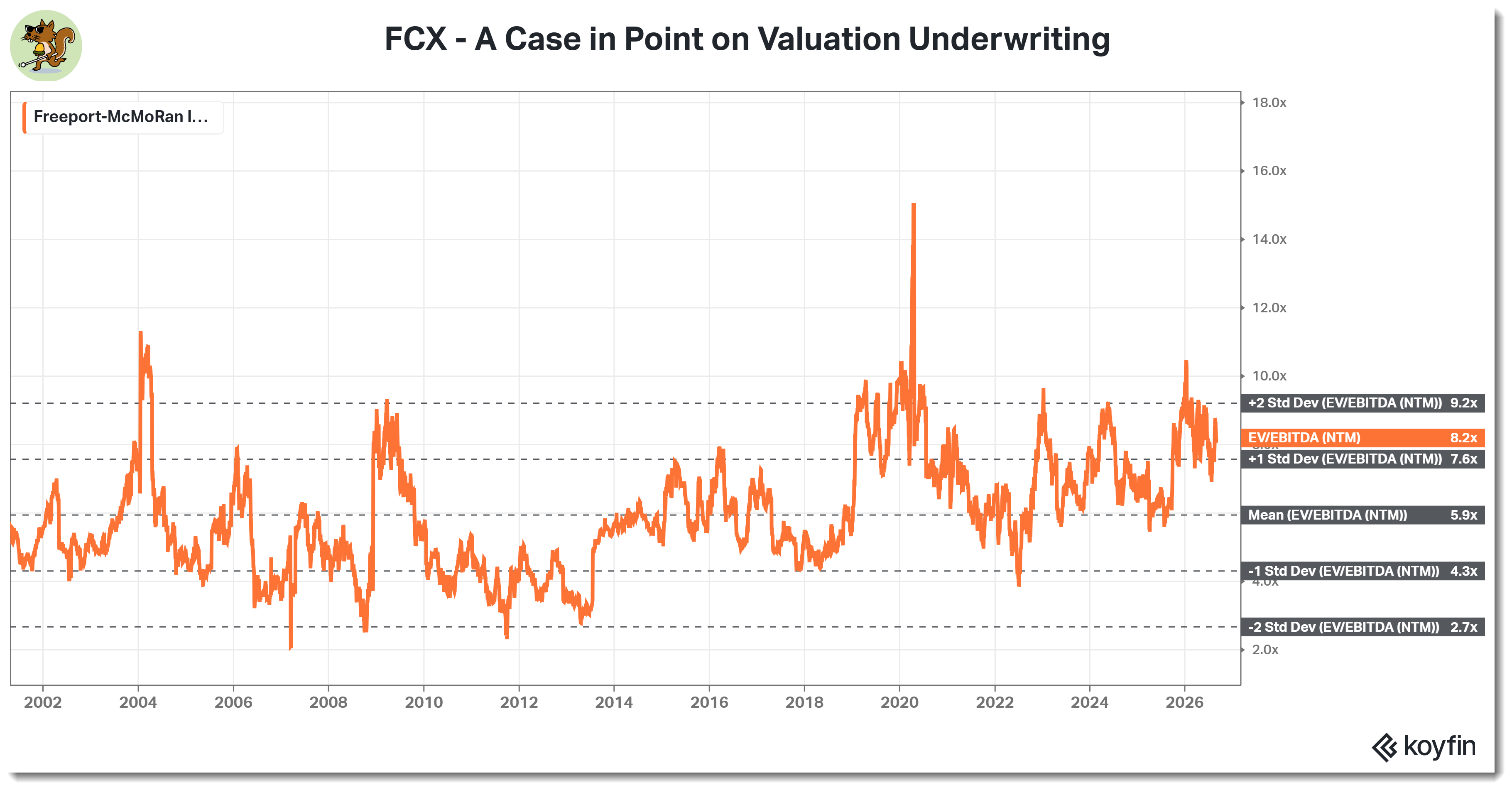
The (T7) world in which ‘AI economics don’t math’ is arguably still one in which copper and uranium markets remain in deficit. But you still want to be careful not to overpay for your copper stocks.
As for nuclear, sometimes a trade feels so obvious that you are obviously wrong. I think about the conversation that Benny and I had with power trader Tom Jens back in February often - “Physics vs. Equity Fairies” - definitely worth a revisit of at least the show notes if you missed it.
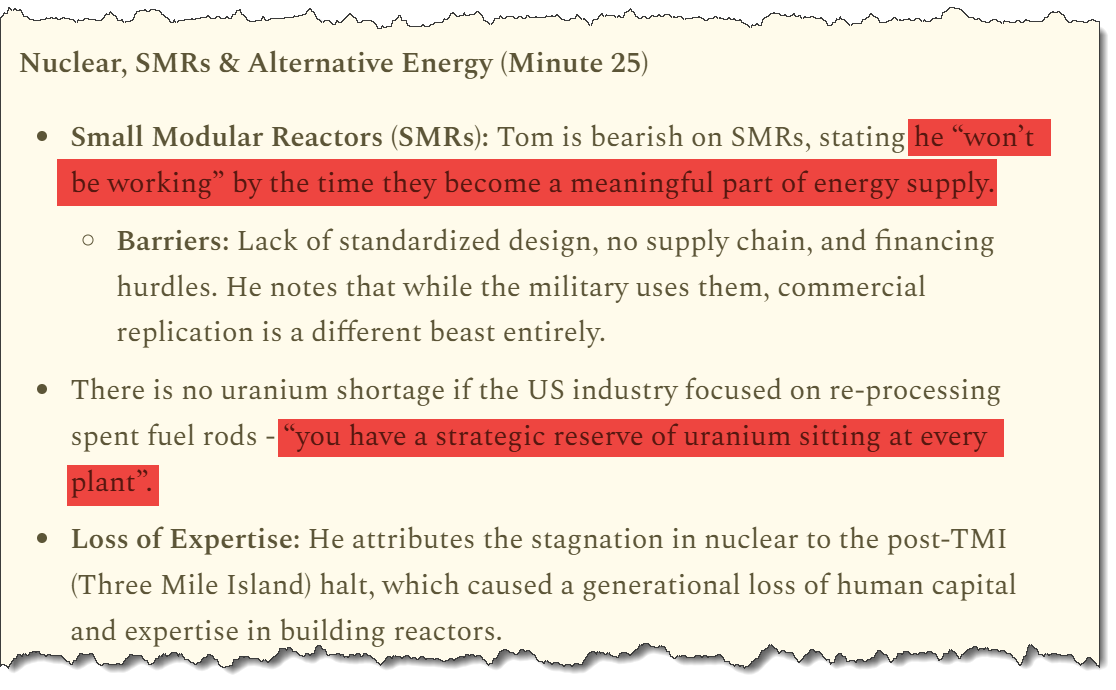
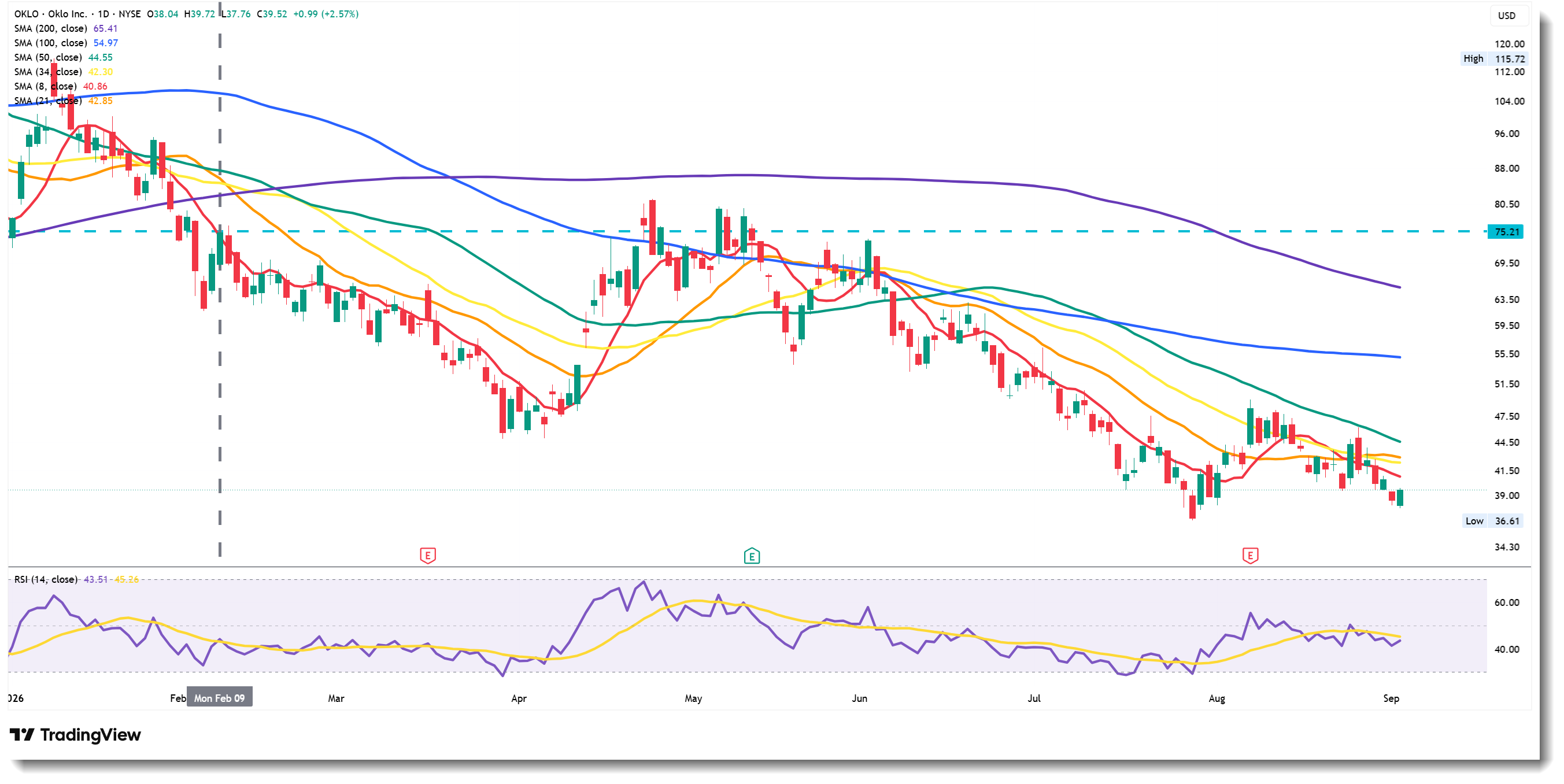
The chat was a major contributor to my decision to bail on uranium and take a short position in SMR play OKLO 0.00%↑ back then.