


The 🐿️ has no interest in sounding like a posher version of the vocal AI bear, Ed Zitron. As such, this week I try to put on an objective corporate finance hat and explore valuation scenarios for the 2 companies whose investment plans are the cornerstone of the current AI boom - Anthropic and OpenAI.
The valuations of OpenAI and Anthropic matter to a universe well beyond their potential IPO buyers. Their funding rounds, jumbo compute contracts and the labs’ web of Silicon Valley equity cross-holdings increasingly sit at the center of the entire AI capex narrative.
Back in April, when attempting to value SpaceX, valuing Starlink and the ‘launch’ business was relatively straightforward. Putting a number on the “jazz hands and pixie dust” that was Musk’s xAI division frankly fell into the ‘too hard’ bucket.
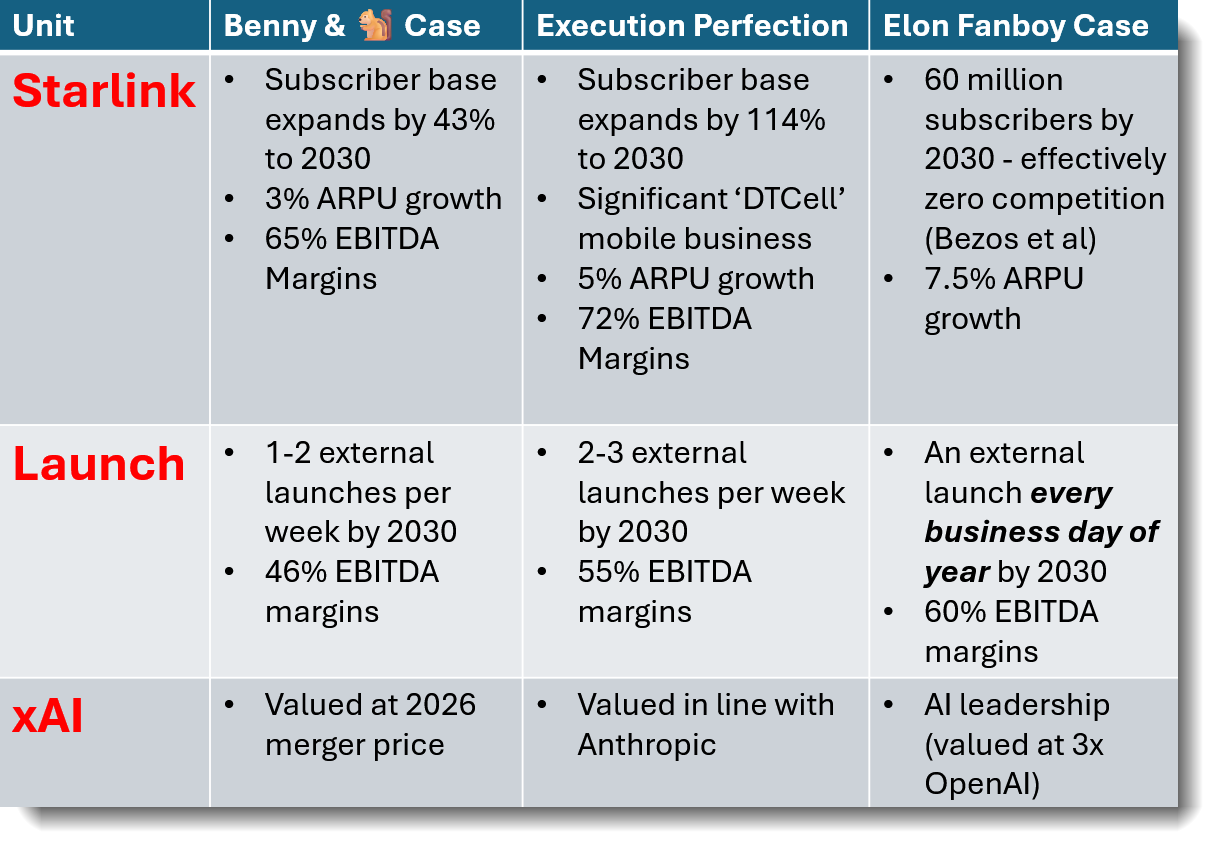
After testing some of the economics of data centers in space (which do not move the needle from a group valuation perspective even if they are physically viable), I was forced to slightly “phone it in” for my 3 valuation scenarios - leaning heavily on the private valuation marks for Anthropic and OpenAI as comps.
With these important IPOs now within view, that “Excel goal seek” approach to business valuation now needs to take a back seat. Goldman estimates that $27 trillion has been added to the value of global equities since the public launch of ChatGPT in November 2022. The foundation labs are the keystone to this move.
GS reckons that the market is pricing in expectation of roughly $19 trillion in future AI-driven revenues. Possibly a problem. Even the most optimistic macro forecasts only point to an additional $5 to $8 trillion of global economic output coming as a direct result of AI.
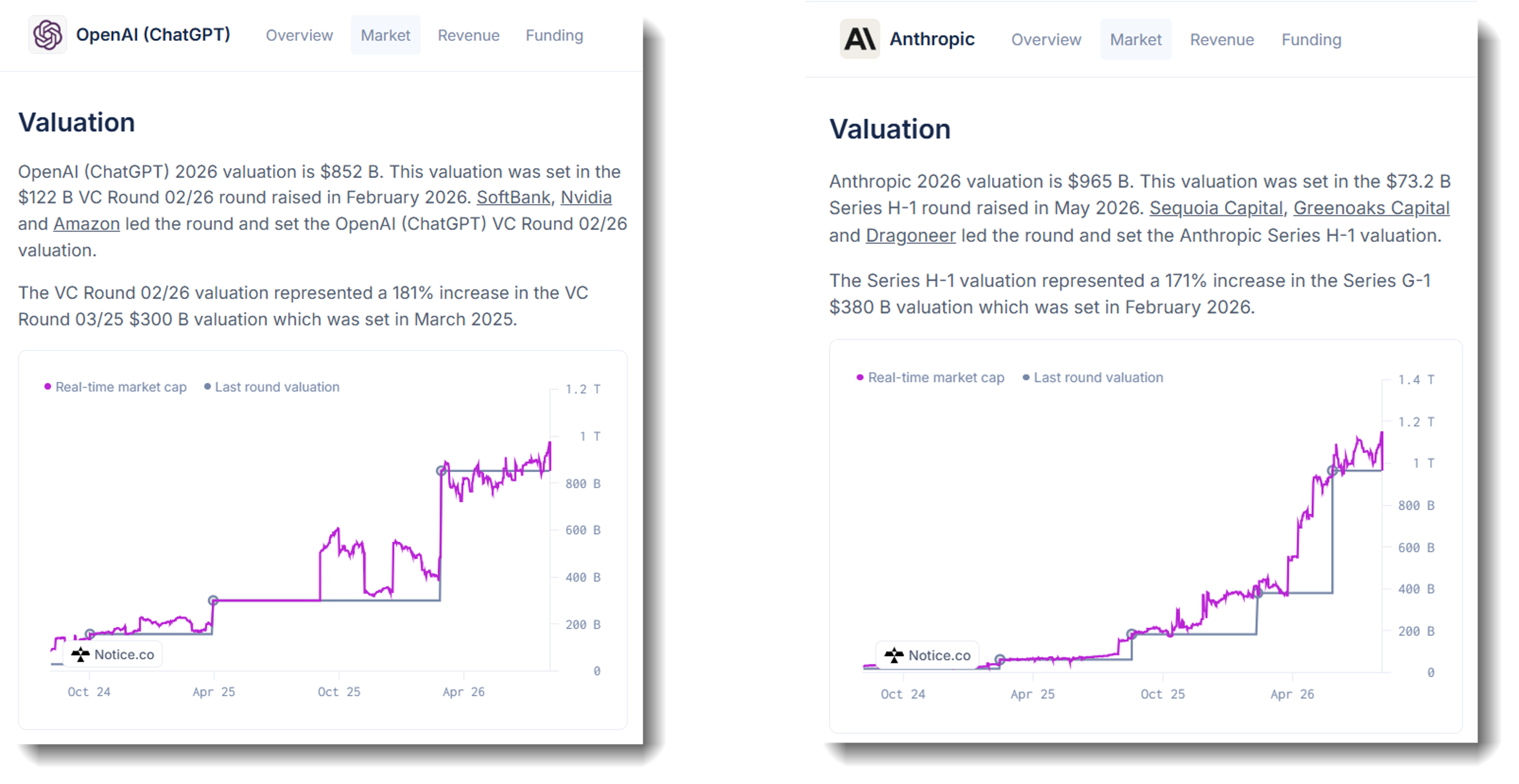
The investment activity and private valuations of OpenAI ($850bn) and Anthropic ($965bn) are the primary narrative supporting the hyperscaler capex boom. Are these businesses “Too Big To Fail” for the tech industry (let alone the US equity market)? And what analysis supports their current private market valuations?
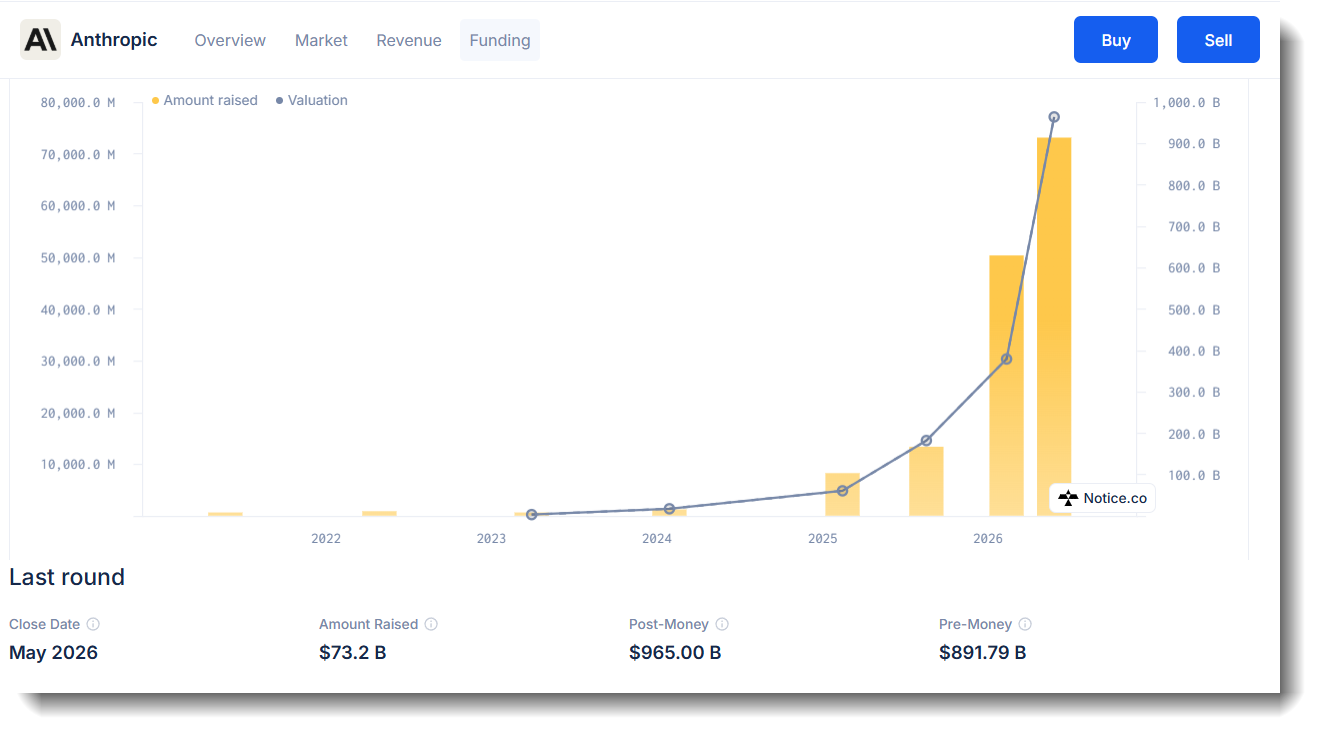
The valuations of both have expanded dramatically during 2026 - big numbers clearly required to support massive private raises for both Anthropic…
…and OpenAI.
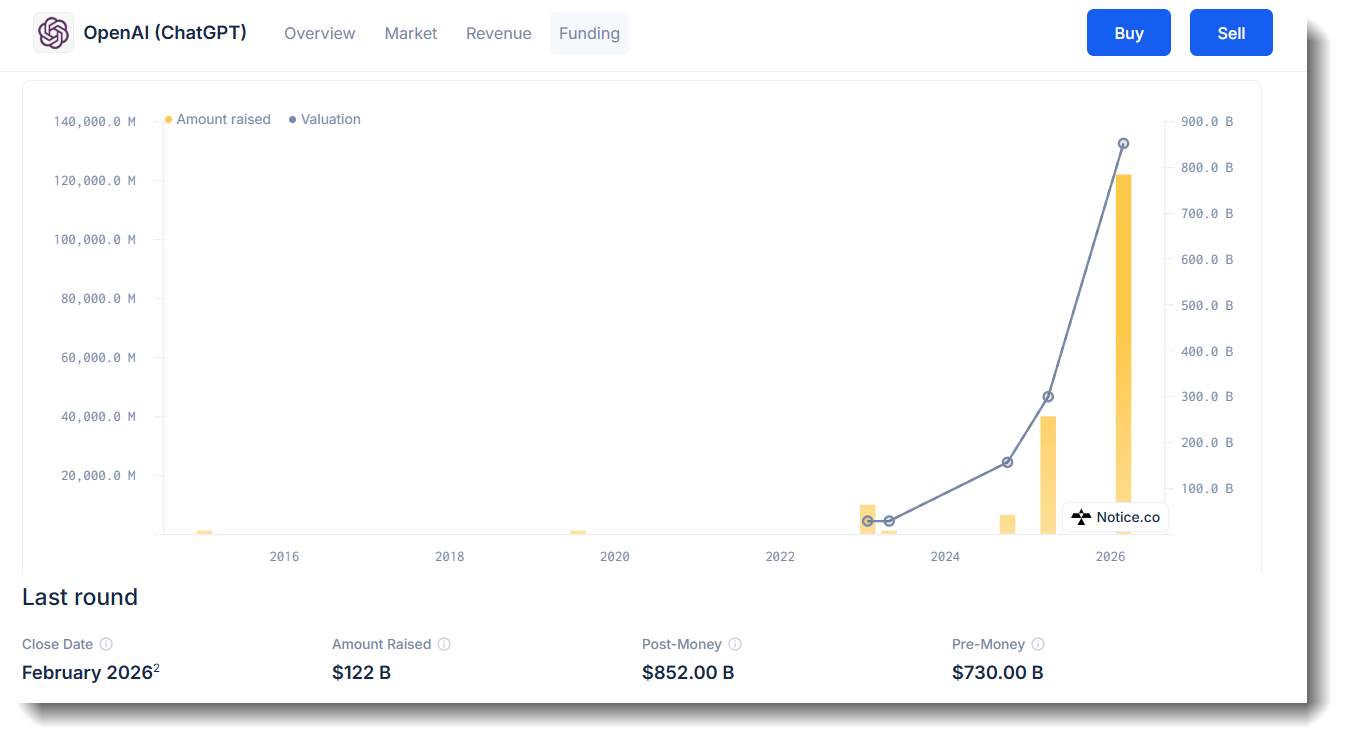
A quick word of warning on private market valuations. Venture capitalists and hyperscalers have been willing to support massive headline valuations because they structure their investments with liquidation preferences, downside protection, or - in Microsoft’s case until recently - direct capture of the compute revenue. Obviously, all of those early investor protections fall away with an IPO.
My job is now to try and frame some numbers around value for their common stock. And there is plenty riding on it!
About that Earnings Bubble
The rally in the AI stocks over the past 2 weeks has of course benefitted from the squeeze dynamics of the ‘Situationally Aware’ wealth transfer from young Leopold Aschenbrenner to Ken Griffin’s Citadel. However, the collective swooning over the latest earnings ‘beats’ from the hyperscalers has been arguably a greater contributor to the rally.
For all this talk of earnings bubbles (MUCH healthier than valuation bubbles apparently😉), the latest numbers contained more than their fair share of what ‘old timers’ used to be call “extraordinary items” - against which valuation multiples would not normally be applied.
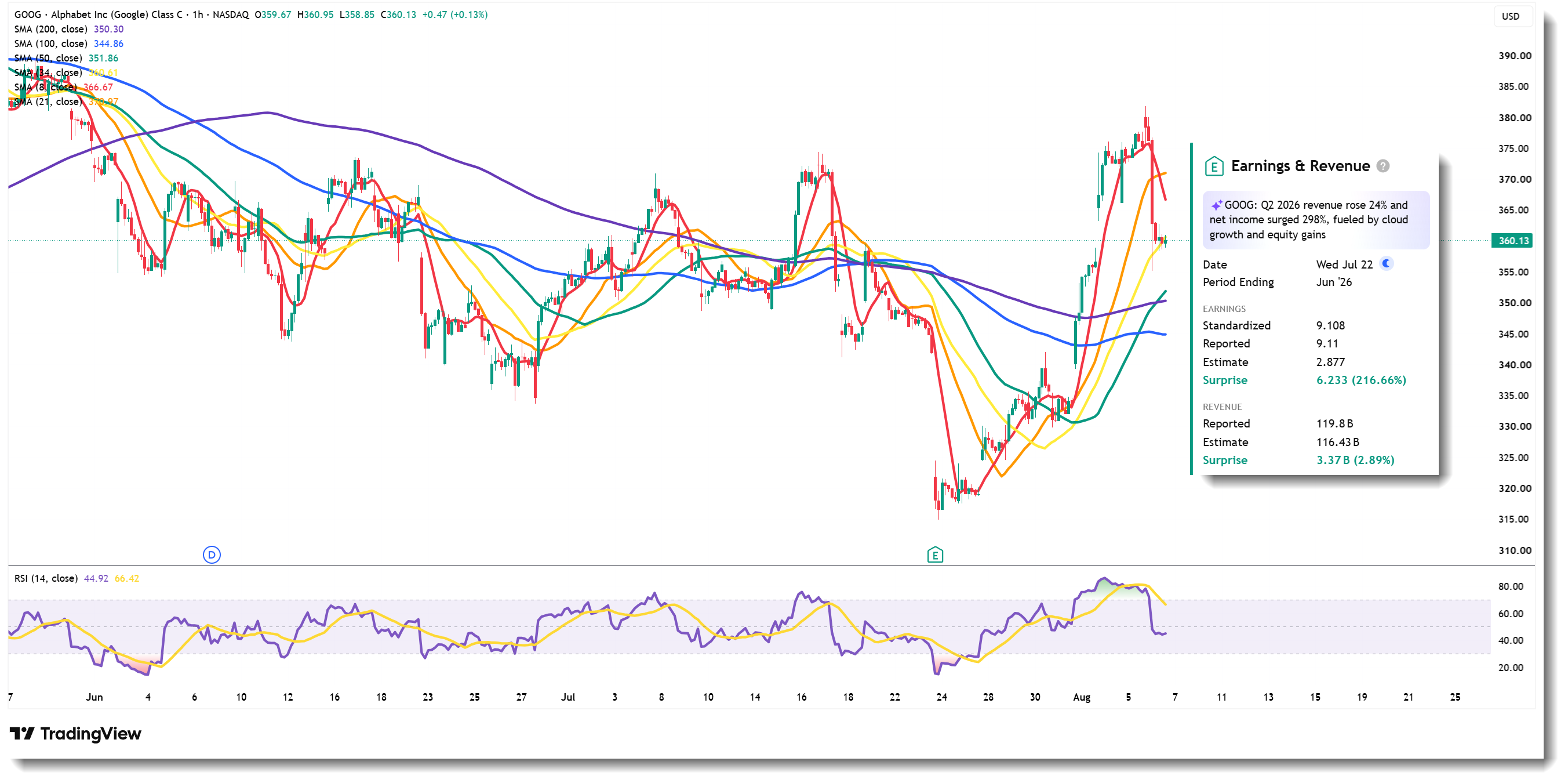
On July 22, 68% (!) of Alphabet’s reported Q2 EPS came from unrealized gains on their holdings of Anthropic and SpaceX (core EPS was a slight miss relative to expectations). Anthropic is expected to account for 44% of Google Cloud’s FY27 revenues.
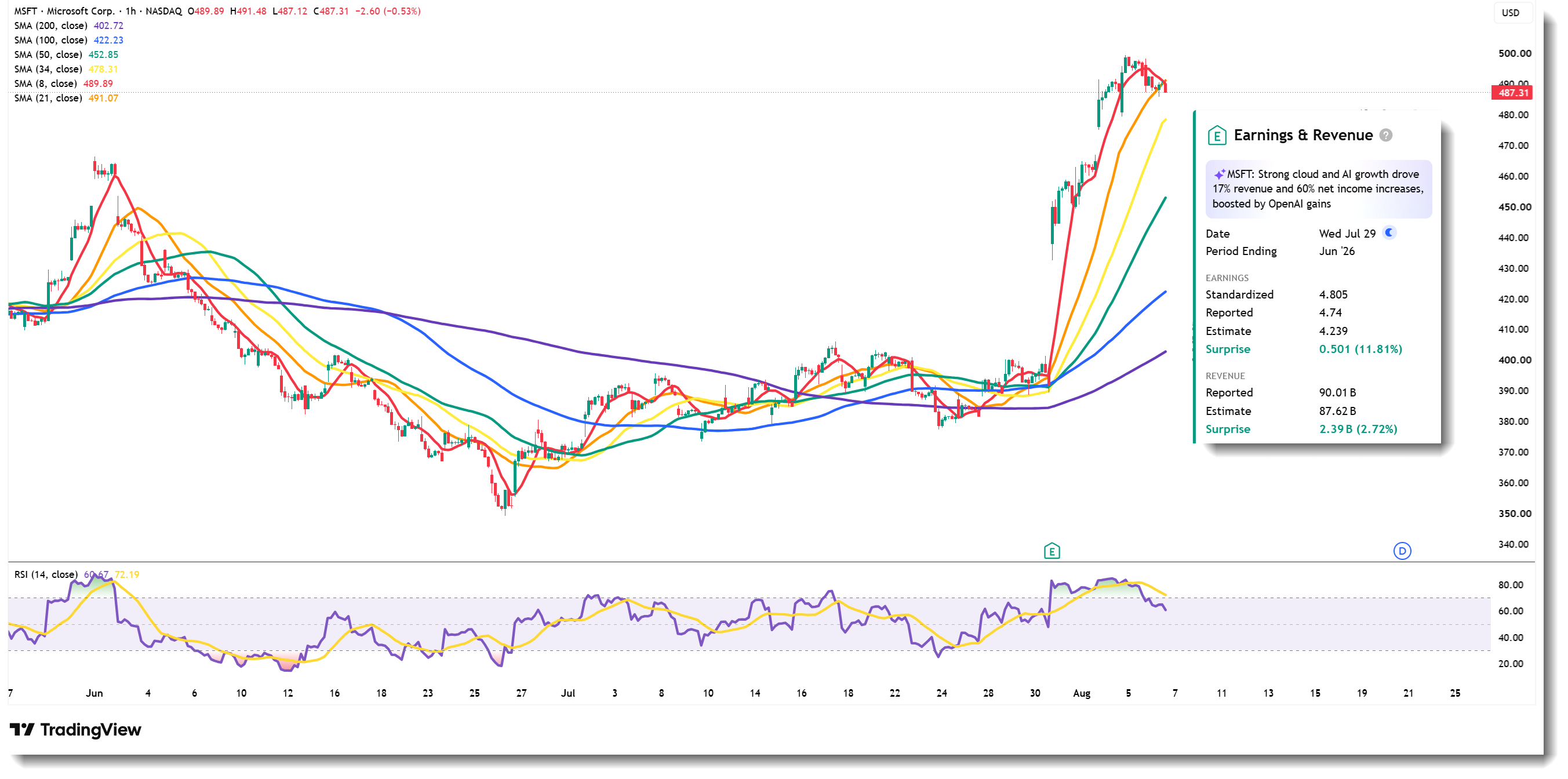
Court filings from the Musk / Altman psychodrama revealed that Microsoft has funneled over $100bn into its OpenAI relationship since inception. Over 70% of Azure’s AI-related revenue is reported to originate from the 2 foundation model companies. Mark-ups from unrealized gains on stakes in the 2 companies delivered the majority of the July 29th ‘beat’.
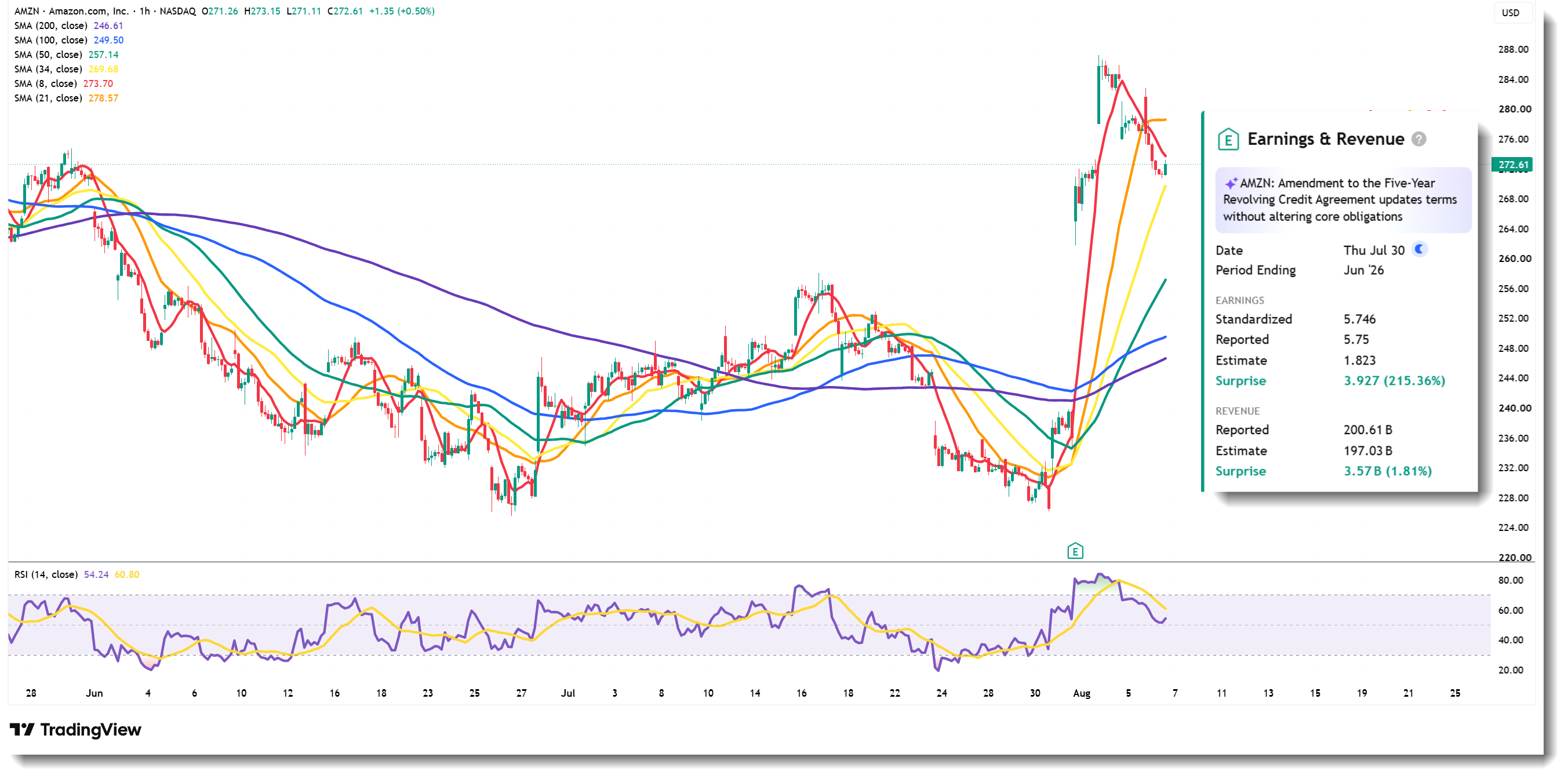
The following day saw Amazon report that its $4.25 per share paper gain on Anthropic dwarfed earnings from global retail and (other) AWS income combined. It’s estimated by Barclays that OpenAI and Anthropic will account for around 80% of total AWS AI revenues this year.
In Defense of the ‘Trillion-Dollar+’ Bull Cases
Before I do the egg-head corporate finance exercise, I want to lay out the uber bull case for the foundation model companies as well as what those cases imply in terms of real world implications.
To justify a $1 trillion valuation for either company, you need to believe that they keep growing fast enough, long enough, and with enough margin expansion to turn today’s model-access business into a durable AI platform. The market needs to get beyond earnings power to a future state where these firms take massive share of global enterprise and consumer AI spend.
For OpenAI Bulls
With ChatGPT approaching a billion monthly users, has OpenAI arguably achieved a consumer distribution monopoly akin to Google’s dominance of search? If so, this creates a massive data moat. Developers will be forced to build on ChatGPT APIs as the only path to those consumers.
This would justify a premium ‘rent’ on those APIs versus open-source alternatives. However, finding a solution for reducing the level of consumer inference subsidy by OpenAI is essential. The bull case also assumes that OpenAI makes MUCH further inroads in the enterprise market.
For Anthropic Bulls
Anthropic is the currently dominant global “enterprise play” - the “trust and safety” partner of businesses and government entities where governance and reputational risk do not allow the routing of sensitive data through cheaper, open-source models.
This regulatory capture enables Anthropic to maintain premium pricing on recurring revenues from enterprise customers. The bull case assumes that they are not just dominating corporate IT budgets but also taking a share from ‘payroll’ with their agentic ‘digital labor’.
For both - the infrastructure ‘moat’
Is compute cost a liability or a moat? OpenAI and Anthropic’s deep partnerships with the hyperscalers give them unrivalled access to the world’s most advanced GPU and TPU training clusters. Their $1 trillion valuations can be justified by calculating the replacement cost and time required for any competitor to match this infrastructure.
Herein lies a dilemma. The foundation model companies cannot get to long-term, sustainable EBITDA margins of 35% while paying so much edge away to the hyperscalers. The bull case therefore also requires major advances in custom silicon that allows them to break free from Nvidia’s pricing monopoly and crush inference costs. I suspect that relationship tensions with their supply chain lie ahead.
Will EBTIT and SaaS Comparisons Fly?
The 🐿️ does not believe that a PARMAP™ - ‘Pick a Revenue Multiple and Pray’ - approach to valuing the foundation model companies is going to get OpenAI and Anthropic public.
AI ‘spokes-folk’ and their outriders are currently floating the concept of EBTIT - Earnings before (model) TRAINING, Interest and Tax - as an alternative valuation metric. I believe this will be just about as persuasive as WeWork’s infamous “Community-Adjusted EBITDA”.
The training of the next frontier model - necessary to remain competitive - is a recurring ‘survival’ operating expense, not one-off capex. And if pricing power collapses while training costs rise, margins invert. No bueno.
Standard SaaS valuation frameworks crumble when the marginal cost of a new user is directly tied to variable compute costs. Standard metrics of customer lifetime value versus acquisition cost are also of questionable use when you consider the threat from the…
Open-Source Bogeyman
The foundation labs are now facing a real competitive threat from highly capable - and certainly good enough for most users - open-source providers. Open-source solutions also offer CTO and CIOs the opportunity to keep their proprietary data out of the hands of the foundation labs.
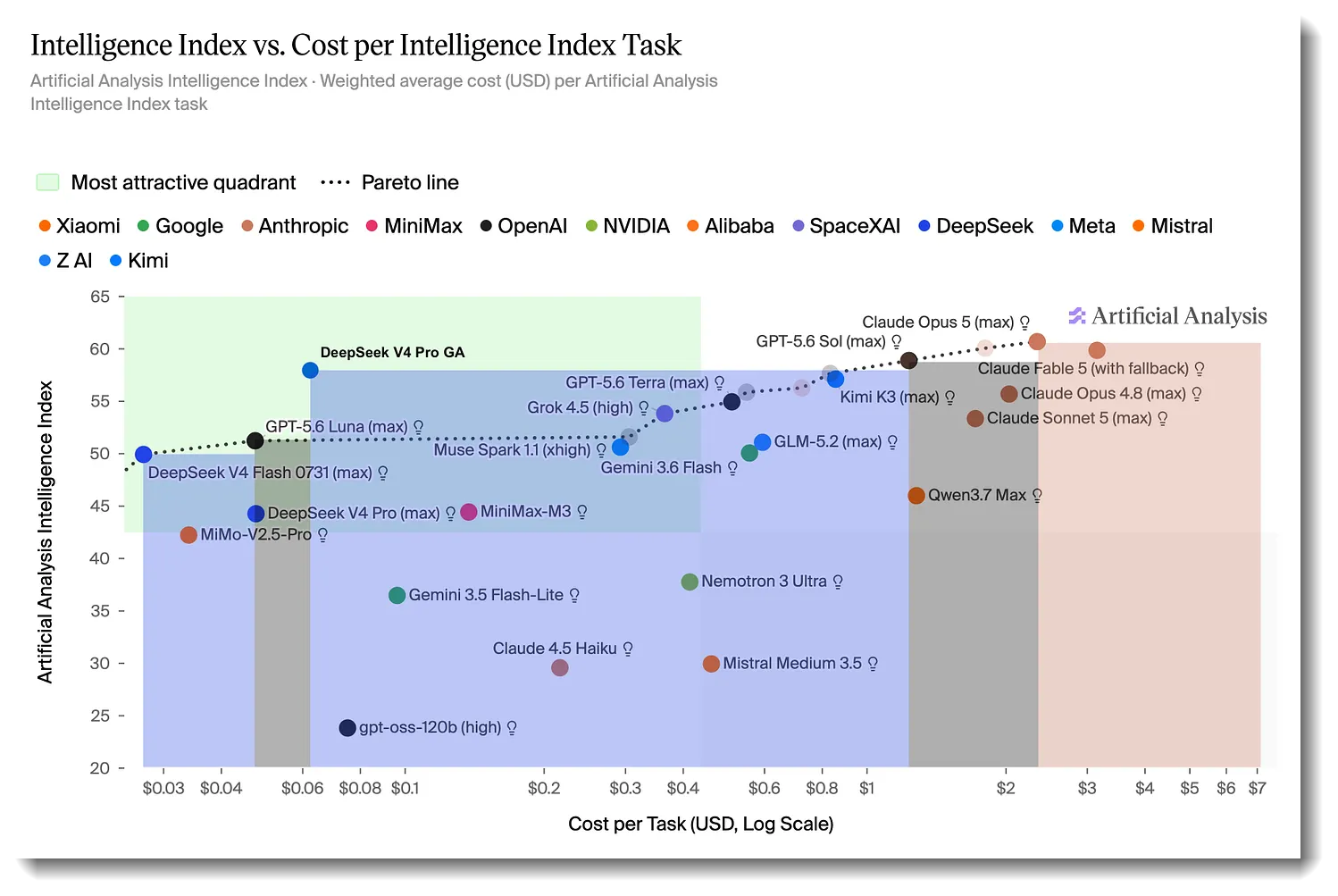
AI developers and CTOs simply cannot afford to ignore the differences in token pricing.

According to OpenRouter data, this week token consumption on DeepSeek exceeded 130% of OpenAI and Anthropic combined (live link to this dataset via the image below).

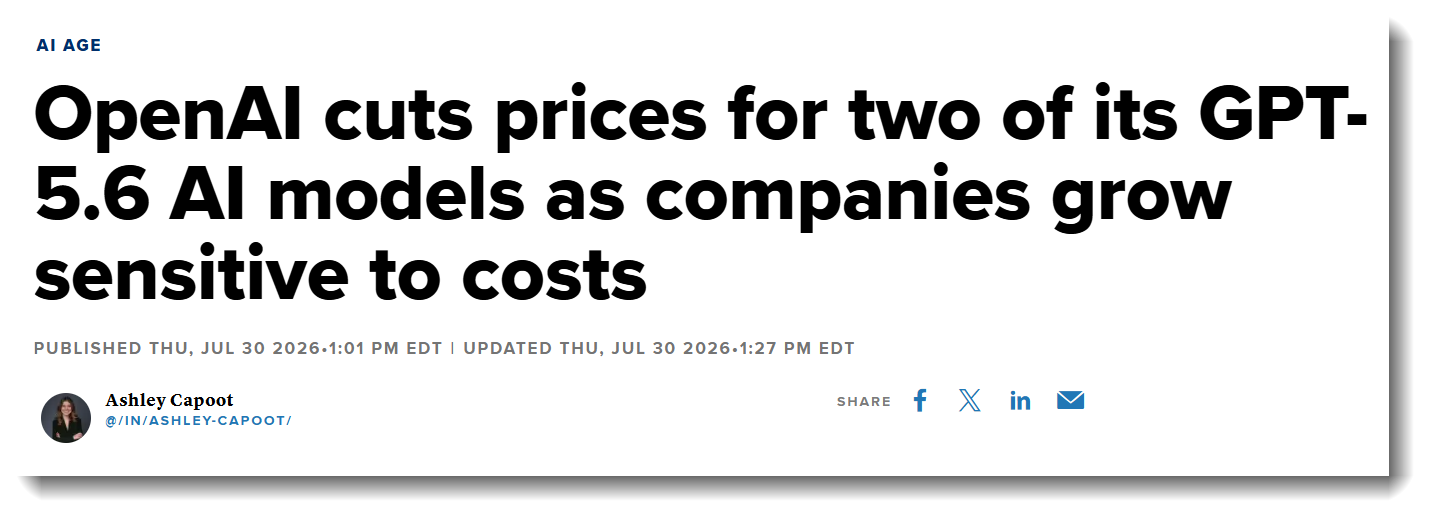
Pricing response from the foundation labs was inevitable.
Valuing the Un-Model-able
The following analysis is going to trigger the AI evangelists and corporate finance purists in equal measure. If I do not achieve that, I am probably doing something wrong.
I have attempted to model 4 income statement scenarios for each of OpenAI and Anthropic out to 2030 - ranging from ‘capital misallocation wipeout’ on the downside and ‘agentic nirvana’ for the bull cases.
In each scenario, I look at three measure of margin:
Contribution margin: This is simply revenue minus inference compute - the direct, variable cost of delivering tokens. Growth without positive contribution margin is an express train to the poor house.
EBTIT margin: This is a nod to the AI ‘spokes-folk’ but, as mentioned above, ignoring model training cost is a measure of business profitability in a vacuum. So, it’s an FYI really.
Regular EBITDA margin: This margin captures the costs of the model training runs and refresh costs. To my view, this has to be the only reasonable number to focus on.
I then apply a range of EBITDA multiples (based on a range of - I hope defendable - steady state outcomes) to forecast 2030 cashflow scenarios and apply a subjective probability weighting to that outcome, discounted back to the present day.
I have used a 20% ‘WACC’ for this. Not exactly text book corporate finance theory, but intended to capture the cocktail of risk that includes technological obsolescence, financing risk, regulation, competitive erosion and complex governance structures (especially in the case of OpenAI).
I am struggling to justify a lower discount rate for businesses that are still incinerating capital at this stage and where there is a non-zero possibility of a total ‘wipeout’ of invested capital.
A downloadable version of the full model is available at the end of the note - so you can play with this assumption directly yourself. Have at it - and PLEASE send me your preferred bull cases! I am trying to remain completely objective.
OpenAI
Revenue and margin summary:
