



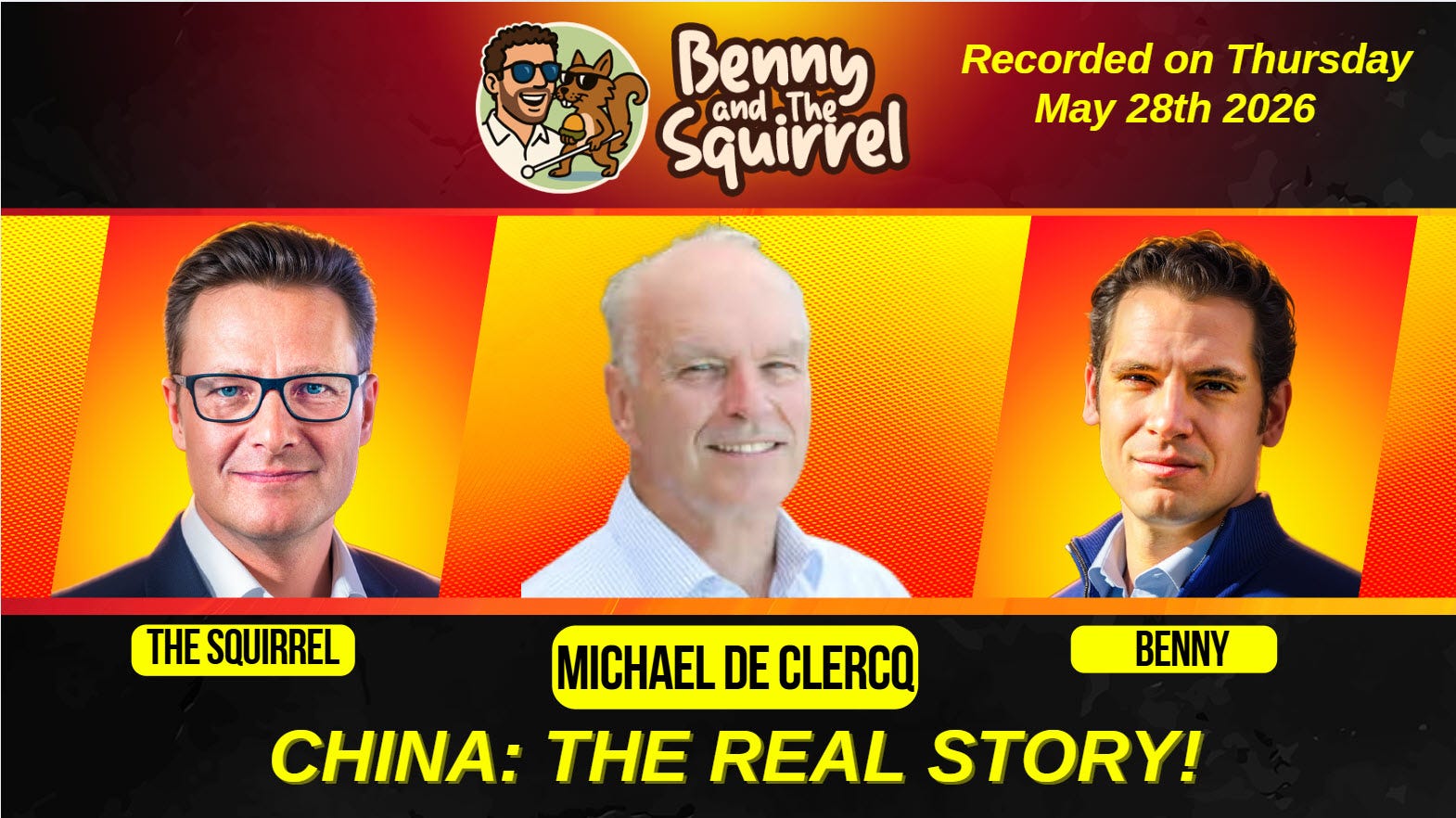
In Episode 54, we welcome Michael De Clercq to the podcast. Michael is the CEO and founder of China Performance Group and someone “who has forgotten more about China than a lot of people will ever know”, having been doing business in China since the late 1970s.
Michael has just launched a Substack on China and Geopolitics. As you will be able to tell from our conversation, I have a hunch that Michael’s thoughts will become essential reading. Sign up here 👇:

The show was recorded at 7pm EST on Thursday 28th May.
I am not able to publish paywalled commentary while on a subscription billing pause - so for the next couple of weeks, enjoy these show notes for free!!
Today’s Slides

Audio only version (for paid subscribers)
Podcast Summary
China’s Rise: Setting the Scene
Michael discusses China’s rise — from a country that couldn’t afford to send delegates to UN events to BYD becoming the world’s best car company
Michael’s own journey has been an “an interesting ride” beginning with his first China trip in 1975, followed by time in Beijing in 1976 for the funeral of Zhou Enlai
Zhou was Mao Zedong’s right-hand man, Premier of China, educated in Paris, and survived the Cultural Revolution through intelligence
Zhou facilitated the secret Kissinger meetings and introduced Mao to the idea of meeting Nixon in 1972 — the first major unlock of China to the West
Michael attended Zhou’s funeral as a 21-year-old on crutches, staying at the French Ambassador’s residence; he notes the genuine mass reverence for Zhou he witnessed
Key Milestones in China’s Rise (Minute 5)
The Deng Xiaoping era: Rise of pragmatism; Deng famously said “there’s nothing wrong with being rich,” unleashing China’s natural mercantile instinct
China was then on a coupon system — money had no real value; you needed rice coupons, mechanical coupons; real estate was not a capital asset
Michael cites Chinese dominance of Southeast Asian wealth (top 10% of richest families in SE Asia are ethnic Chinese under Indonesian, Thai, Malaysian names) as evidence of this deep commercial instinct
2001: China’s accession to the WTO as the next big milestone
1989: The Tiananmen incident — Michael lived in Beijing at the time; Western companies threatened to leave but were “too committed already” and stayed
Michael’s Personal Commercial Journey in China (Minute 10)
Michael studied Chinese at ANU in Canberra; fellow students told him it was “completely useless for business” — only useful for Taiwan trade; he was better off learning Japanese
He graduated and opened an office in China in 1978 — “no logical rationale, incredibly risky,” no bank would finance the business plan
Immediately created a two-tiered business: supply chain/sourcing (now the core of CPG today), and a second consulting arm
He predicted China would become a massive manufacturing base for the West; when working with the US-China Business Council, China was doing just $350 million in exports to the US; officials doubted it would ever reach $500M — now it’s in the $450 billion range
Chinese factories in the late 1970s weren’t particularly interested in selling — pricing was driven by the need to acquire US dollars, not by product cost
All buying had to go through Beijing’s central foreign trade corporations; you couldn’t visit factories or negotiate with provincial entities
Products were garments and footwear; you bought “hundreds of thousands of dozens of shirts” nearly as a commodity, specifying sizes, colours, yarn, dye — you didn’t know where the factories were
By the mid-1980s, private Chinese enterprises were allowed to trade directly with the West — a pivotal change
Industrial Clusters: China’s Natural Organizing Principle (Minute 17)
We discuss regional specialisms and when this cluster model formed
Michael explains clusters formed organically in the 1980s through copycat behavior — factories saw neighbors making money and replicated, which drew in support industries (yarn, buttons, lining) nearby, amplifying competitiveness
This contrasts with the Western obsession with USP and moats: “The Chinese government actually promotes competition and is against monopolies to the extent they can control” — a key reason Chinese equities haven’t tracked China’s economic growth
Why Chinese Equities Have Underperformed (Minute 20)
Chinese equities haven’t done well despite China’s growth; Michael explains Chinese companies (e.g., BYD) are brilliant at penetrating their own market but the West’s analytical framework excludes them
The reason: difficulty valuing Chinese assets (all within Chinese geography), lack of transparency, and China’s own economic moat — the controlled currency and protected market
Historical lesson: China’s awareness that isolation caused its fall (Opium Wars 1842, loss to the East India Company; defeat by Japan — a former vassal state) drove Deng’s opening-up logic
The CCP’s Optimization Strategy vs. the West (Minute 27)
The West optimizes for profit; China optimizes for full employment and retaining power
Michael identifies 2013 (Xi Jinping’s ascension) as a new milestone — a “left turn” from free-market capitalism, which had become “predictably quite corrupt” (pay the right people, get things done)
Xi’s anti-corruption campaign cleaned up political competitors and the corruption culture — economic potential wasn’t significantly damaged
Michael’s core thesis: the CCP sees itself as “the new imperial dynasty”, seeking to rule for a thousand years, driven by a genuine belief they are the solution to making China great again
In the 1700s, China was the largest economy in the world by a long shot; the Opium Wars, Boxer Rebellion, and defeat by Japan reduced it to “the poor man of Asia” — leaving a deep chip on the shoulder of Chinese patriotic leadership
Distinction from MAGA: China’s desire to be great again is genuine historical restoration; “America was great to start off with and continues to be great”
Unlike Cuba (hold power regardless of national welfare), the CCP holds power because they believe they can make China great — so they invest in education and poverty reduction even though a nation of 10 million unemployed university graduates creates dangerous social discontent
The Chinese Consumer Market: Why the Engine Never Quite Starts (Minute 36)
We discuss what’s preventing the “Chinese consumer engine” from turning on — every foreign business has dreamt of 1.2 billion consumers
Michael identifies two structural barriers: the lack of a welfare system and the hukou system
Welfare paradox: Despite being communist (which Westerners assume means generous welfare), China’s social safety net is no better than the US system — Chinese people hoard savings as insurance against hospital costs and life events; they are “great savers and poor consumers”
Consumer spending is only 25–45% of Chinese GDP vs. 65%+ in the US
Xi Jinping is personally afraid of welfare-induced laziness — so he won’t expand it
The CCP’s substitute for welfare: manufactured holidays — when Michael started working there, people worked 7 days a week; the CCP discovered holidays drive spending and now creates multi-day holiday blocks (e.g., tomb sweeping day + weekend = 5-day block, but workers make up days the prior weekend)
Hukou ties your rights as a citizen (free schooling, kindergarten, social services) to your birthplace; moving to an urban center means losing those rights
Historically 80%+ of China’s population was rural; urban migration happened through informal “turning a blind eye” because cities needed workers
Second- and third-tier cities (e.g., Hefei) are beginning to waive hukou requirements to attract workers and boost local consumption — an early-stage reform
The core reason: social stability — the #1 metric by which every Chinese provincial governor and city mayor is measured
Hukou is a social control mechanism; abolishing it risks instability in urban centers
Michael agrees that technology (AI, surveillance) could replace the hukou’s control function; second- and third-tier cities are already evolving it; but it will take 5–10 years to phase out entirely
Taiwan: The Risk/Reward Analysis (Minute 46)
Ben asks for Michael’s view on the real risk of a Taiwan invasion — “the number one thing market participants love to talk about”
Michael is very confident there is no imminent military risk of PRC invasion of Taiwan
Historical background on why Taiwan matters to Beijing: In 1949, Chiang Kai-shek and the Kuomintang fled to Taiwan “temporarily to regroup” with China’s capitalist elite — it remains “unfinished business” in the CCP-KMT civil war
Taiwan is also an ideological embarrassment: an average Taiwanese is roughly 11 times richer than an average mainland Chinese — a Western capitalist system that directly contradicts the CCP’s narrative that communism is the only path to Chinese greatness
But historically, Taiwan didn’t even “belong” to China until ~200 years ago — it was Japanese for a long time and is ethnically Polynesian at its origins
Why Invasion Won’t Happen: Risk > Reward (Minute 54)
The reward: Taking back the island (primarily a political win, not about chips — “that’s not the real reason”)
The risk: The CCP loses power — Xi Jinping’s #1 fear is not Trump, Putin, or the Uyghurs; it’s the Chinese people rebelling
If China attacks Taiwan and fails, the CCP faces potential loss of legitimacy; if it succeeds, it invites global sanctions — destroying China’s role as “the factory for the world”
It would essentially be a civil war — Chinese armed forces killing Chinese people, “never a good look”
Taiwan as a deterrent card: The CCP uses Taiwan as a brilliant negotiating card to be pulled out when useful; the moment they execute on it, they lose that card forever.
Ukraine lesson: Russia had to cross a line in the sand — not 85 miles of water — and look what happened; “the Communist Party pays attention to that”
The 🐿️ and Benny’s RMB Bet (Minute 59)
Rupert asks Michael to adjudicate their long-running bet (18 months old) on the RMB: Rupert believes the RMB will strengthen vs USD (strike price: 6.50); Benny believes it will devalue
Michael’s analysis: Everything the CCP does is politically driven; the RMB is a tool to dethrone the dollar — “quixotic to say the least” given the dollar’s dominance in global trade
But: if any currency could challenge the dollar, it’s “the currency of the country that makes everything for the world” — the supply chain logic is real
Belt and Road, soft power initiatives, and Trump’s antagonizing of trading partners all inadvertently help the RMB’s reserve currency ambitions
The euro is ranked #2 but won’t displace the dollar; the yen won’t either; the RMB’s potential is huge
CCP wants the RMB stable (not volatile like a yo-yo) to project confidence in China’s economic power; they indirectly manage it without directly striking a price
Michael sides with Rupert on RMB strengthening — Rupert quips: “Firmly in the squirrel’s camp”
If you act on anything provided in this newsletter, you agree to the terms in this disclaimer. Everything in this newsletter is for educational and entertainment purposes only and NOT investment advice. Nothing in this newsletter is an offer to sell or to buy any security. The author is not responsible for any financial loss you may incur by acting on any information provided in this newsletter. Before making any investment decisions, talk to a financial advisor.